
Table of Contents
Epoxy paint and epoxy floor coating are not the same product, and the difference matters when choosing a finish for a Brisbane tile floor. Epoxy paint is a latex-based coating with a small amount of epoxy that behaves like a durable paint, while a true epoxy floor coating is a two-part thermosetting polymer that bonds chemically with the substrate for a much harder, longer-lasting surface. Epoxy Brisbane uses professional-grade two-part epoxy systems, not paint products, across all floor coating installations.
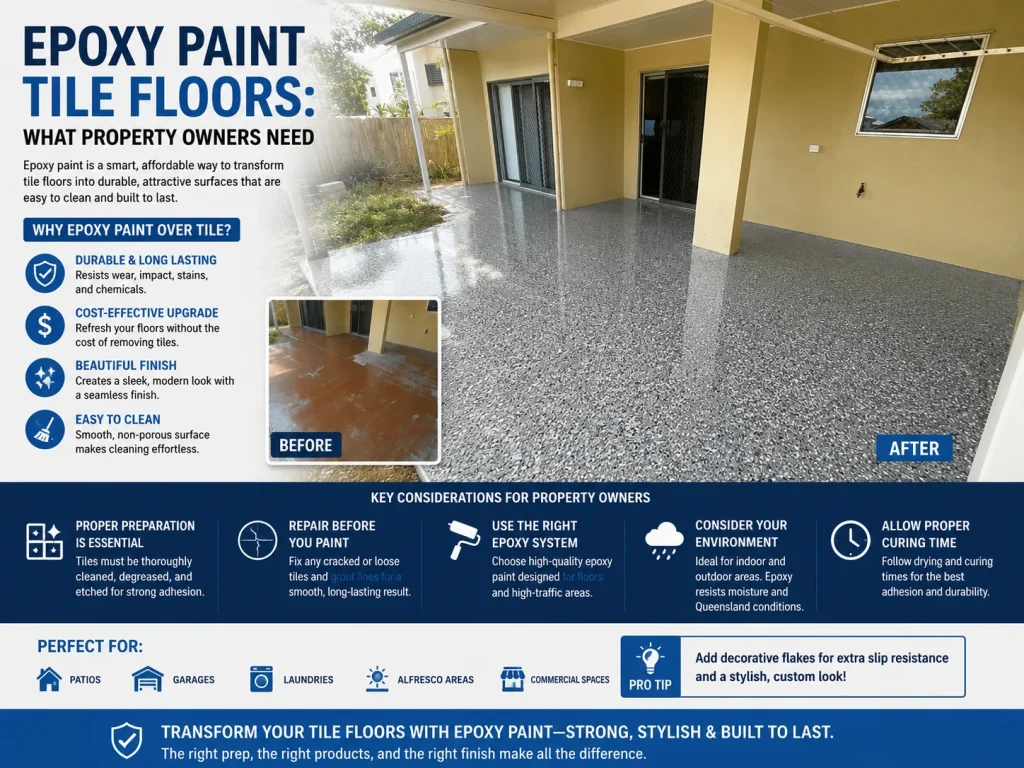
Epoxy Paint vs Epoxy Floor Coating: Why the Difference Matters on Tiles
The term epoxy paint is used loosely in home improvement contexts to describe a range of products, from latex paint containing a small amount of epoxy resin to full two-part epoxy systems. For tile floor applications, the distinction between these product types has significant implications for how the finished floor performs and how long it lasts.
True epoxy floor coatings are two-component systems. The resin and hardener are mixed immediately before application, triggering a chemical reaction that cures the product into a rigid, cross-linked polymer matrix. This chemical cure creates a surface that is significantly harder and more chemically resistant than any paint product. A two-part epoxy coating applied over a correctly prepared tile floor will typically last ten to fifteen years in residential environments and seven to ten years in commercial settings with regular traffic.
Epoxy paint, in contrast, is a single-component product that is cured by evaporation, the same way any acrylic or latex paint does. It is thinner, softer, and less resistant to the mechanical and chemical stresses that a floor surface experiences. On a tile floor, where the preparation requirements are already more demanding than on concrete, epoxy paint applied without the correct primer and surface profile will peel, chip, and deteriorate relatively quickly, particularly in a garage, kitchen, or any space where it sees regular traffic and exposure.
When People Search for Epoxy Paint on Tile Floors in Brisbane
The search intent behind epoxy paint tile floor queries splits into two groups. The first group is looking for a quick, low-cost refresh of an existing tile floor and is considering a paint product that can be applied relatively easily without professional preparation. The second group wants to know whether a professional epoxy floor coating system can be applied over existing tiles, and is using paint as shorthand for coating.
For the first group, the honest advice is that a paint product applied to a tile floor will deliver a surface that looks acceptable initially and deteriorates sooner than expected. Tiles are non-porous and glazed, which means adhesion for any paint or coating product depends entirely on mechanical preparation of the surface. Without proper grinding and specialist primer, even a quality paint product will begin peeling within months in a high-traffic or wet environment.
For the second group, the answer is that a professional two-part epoxy system absolutely can be applied over suitable tile floors, and the results are significantly better than any paint product. This is what Epoxy Brisbane installs. The preparation process is thorough, the product specification is correct for the substrate, and the finished result is a genuine epoxy floor coating, not a paint film over tiles.
What a Professional Epoxy System on a Tile Floor Actually Involves
A professional epoxy installation on a tile floor is a multi-step process that begins with surface assessment and ends with a topcoat applied over a correctly primed and leveled substrate. The preparation steps are the same regardless of the finish specified.
Diamond grinding removes the tile glaze and creates the surface profile the primer needs to anchor to. Grout lines are filled with a ceramic screed compound and ground flush with the tile surface. A primer formulated for non-porous substrates is applied to create the chemical bond between the tile and the epoxy body coat. Shot blasting may be included for larger or heavily contaminated floors where grinding alone does not achieve the required surface cleanliness.
The body coat is then applied, followed by a decorative layer where specified, and a polyurethane topcoat that protects the system from UV, abrasion, and chemical exposure. This is a genuine floor coating system, not a paint application. The hardness, chemical resistance, and adhesion of the finished surface are categorically different from any paint product.
Tile Types and Their Suitability for Professional Epoxy Coating
Ceramic tiles in sound condition are the most common substrate for professional epoxy coating in Brisbane residential properties. Ceramic is relatively straightforward to grind and accepts primer well when the glaze is fully removed.
Porcelain tiles are harder and denser than ceramic, which means they require more aggressive grinding to achieve the required surface profile. The preparation takes longer, but porcelain in good condition is a suitable substrate for a professional epoxy system.
Natural stone tiles, including travertine, marble, and slate, present more variable surface conditions and are assessed individually. The porosity, surface texture, and grout characteristics of natural stone make adhesion more complex, and the assessment determines whether an over-coat is viable or whether tile removal and concrete resurfacing is the more appropriate path.
Textured tiles, including raised-pattern ceramic and anti-slip outdoor tiles, may require more preparation work to achieve a consistent surface profile before priming. The assessment for textured tile floors includes an evaluation of whether the texture can be adequately ground and levelled before the epoxy system is applied.
Environments That Benefit Most from Professional Epoxy Coating Over Tiles
Residential garages with sound ceramic or porcelain tile floors are consistently strong candidates for professional epoxy coating. The garage epoxy flooring service covers tile substrate assessments and over-coat installations across Brisbane’s northern suburbs, southern suburbs, and the Moreton Bay region.
Commercial kitchens where tile removal would cause operational disruption are frequently assessed for professional over-coat suitability. A correctly installed commercial kitchen flooring epoxy system over sound tiles eliminates grout lines, meets slip-resistance requirements, and provides a hygienic surface that satisfies food safety expectations. Queensland’s food premises standards, as detailed by the Queensland Government’s food premises and equipment guidance, set the surface and hygiene requirements that a correctly specified two-part epoxy system over tiles satisfies.
Workshop floors and light industrial spaces with intact tiled surfaces are also assessed regularly. Where the tile condition supports an over-coat, a professional workshop flooring epoxy system delivers the chemical resistance, impact durability, and cleanability that these environments require.
What to Look for When Comparing Products and Providers
If you are gathering information on epoxy options for a tile floor in Brisbane, a few questions will quickly clarify the quality of what is being offered. Ask whether the product is a single-component paint or a two-part epoxy system. Ask what the surface preparation scope includes and whether grinding and specialist primer are part of the process. Ask whether the provider carries a current QBCC licence, which confirms that the business meets Queensland’s regulatory standards for floor coating work.
The QBCC’s guidance on finding a licensed contractor outlines how to verify that a flooring contractor holds a valid licence before any work is agreed. The QBCC floor finishing and covering licence is the specific credential required for professional floor coating work in Queensland.
Epoxy Brisbane holds a current QBCC licence, uses professional-grade two-part epoxy systems on all installations, and carries out a full tile assessment and preparation scope on every tile floor project. To discuss your tile floor and the options available, call 1300 321 433 or visit the project gallery to review completed installations.
Frequently Asked Questions
1. Is epoxy paint the same as epoxy floor coating?
No. Epoxy paint is a latex or acrylic product that may contain a small amount of epoxy resin and cure by evaporation. A true epoxy floor coating is a two-part system of resin and hardener that cures by chemical reaction into a rigid, cross-linked polymer. The hardness, thickness, chemical resistance, and lifespan of a two-part epoxy coating are significantly greater than any epoxy paint product. For tile floor applications in residential and commercial environments, a two-part system is the correct product specification. For a direct comparison of how these products perform over time, see our epoxy flooring durability guide.
2. Can I use epoxy paint on bathroom tiles in Brisbane?
Epoxy paint products are sometimes marketed for bathroom tile applications, but their durability in a wet, high-traffic environment is limited. A professional two-part epoxy system applied over correctly prepared bathroom tiles will significantly outperform any paint product. The key requirements for bathroom applications are moisture assessment of the substrate, specialist primer for non-porous tiles, and a non-slip aggregate in the topcoat. Each bathroom floor is assessed individually before coating is recommended. Visit our residential epoxy flooring page for more on what residential applications involve.
3. How much does epoxy paint tile floor treatment cost in Brisbane?
Paint products can be purchased retail for a fraction of the cost of a professional epoxy installation, but the performance and lifespan difference is significant. A professional two-part epoxy system installed by Epoxy Brisbane over a prepared tile floor reflects the cost of the correct product, the preparation labour, and the installation expertise. The actual cost depends on floor size, tile condition, and finish specified. A site assessment is the only way to provide an accurate project cost. Our epoxy flooring cost guide provides a realistic overview of what influences pricing across different project types in Australia.
4. How do I know if my tiles need to be removed before epoxy is applied?
The key indicators are widespread tile debonding (hollow sound when tapped), multiple cracked tiles, severely deteriorated grout, and height constraints at doorways. Any one of these factors may make tile removal the more appropriate option. An on-site assessment by Epoxy Brisbane identifies all relevant factors and provides an honest recommendation on whether over-coating or removal is the right choice for your specific floor. Where tile removal is the better path, concrete resurfacing prepares the substrate correctly for a long-lasting epoxy system.
5. What finish options are available with professional epoxy on tile floors?
A professional two-part epoxy system on a correctly prepared tile floor can be finished in any of the options available for concrete substrates. Solid colour systems, decorative flake finishes broadcast into the wet body coat, and metallic systems with pigmented resin are all applicable. The finish choice is made based on the environment, the aesthetic goal, and the performance requirements of the space. Flake design options are available in a wide range of colour combinations and flake sizes.
Get the Right Product for Your Brisbane Tile Floor
The choice between a paint product and a professional two-part epoxy system will determine how your tile floor performs and how long the result lasts. Epoxy Brisbane uses professional-grade epoxy systems, carries out full tile assessments, and completes every installation to QBCC-licensed standards. Call 1300 321 433 or visit the residential flooring section to discuss the right approach for your floor.
Key Takeaways
- Epoxy paint and two-part epoxy floor coating are different products with significantly different performance characteristics.
- Epoxy paint cures by evaporation and produces a thinner, softer surface. A two-part epoxy cures by chemical reaction into a rigid, cross-linked polymer.
- On a tile floor, a two-part epoxy system with correct preparation will last ten to fifteen years in residential use.
- Surface grinding, specialist primer, and grout levelling are required for both paint and coating products applied to glazed tiles.
- Ceramic and porcelain tiles are the most suitable substrates. Natural stone and textured tiles require individual assessment.
- Epoxy Brisbane uses professional two-part systems, holds a QBCC licence, and assesses every tile floor before installation.
