

Table of Contents
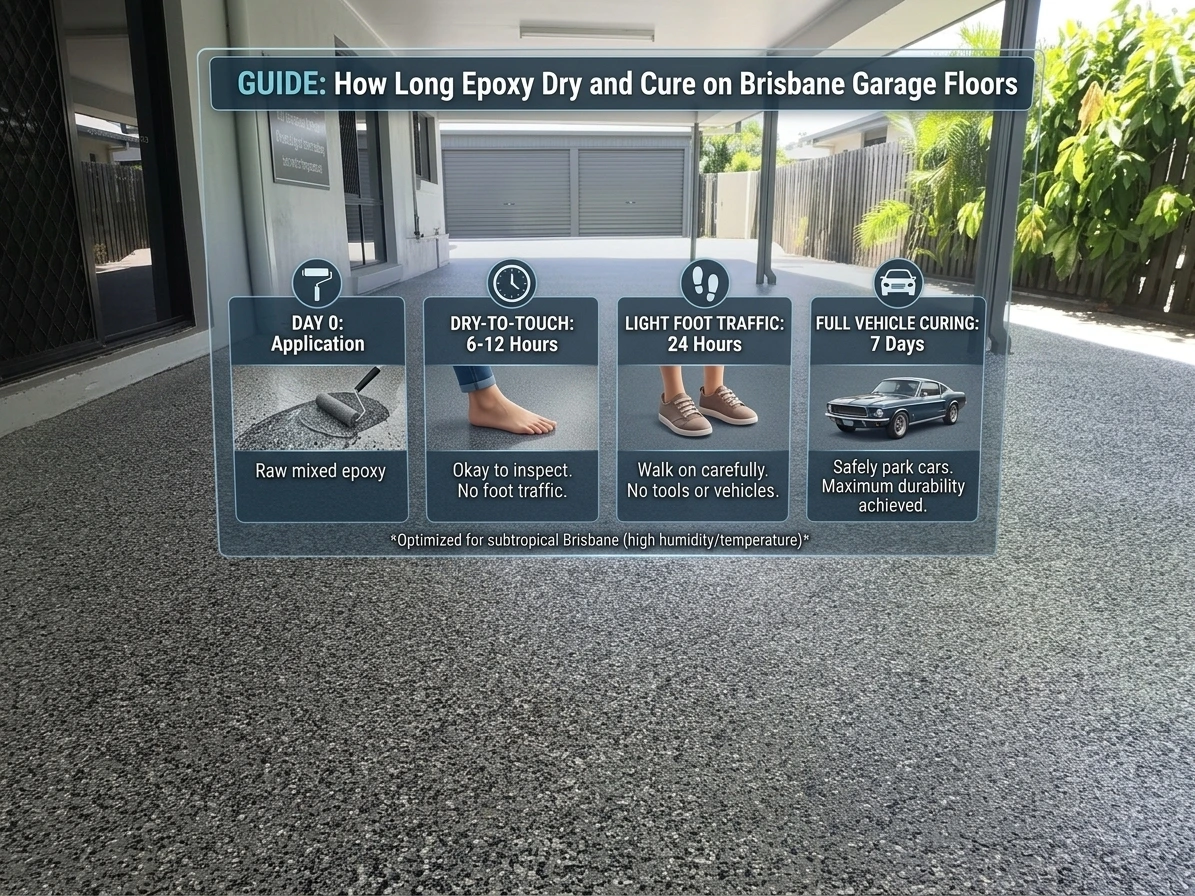
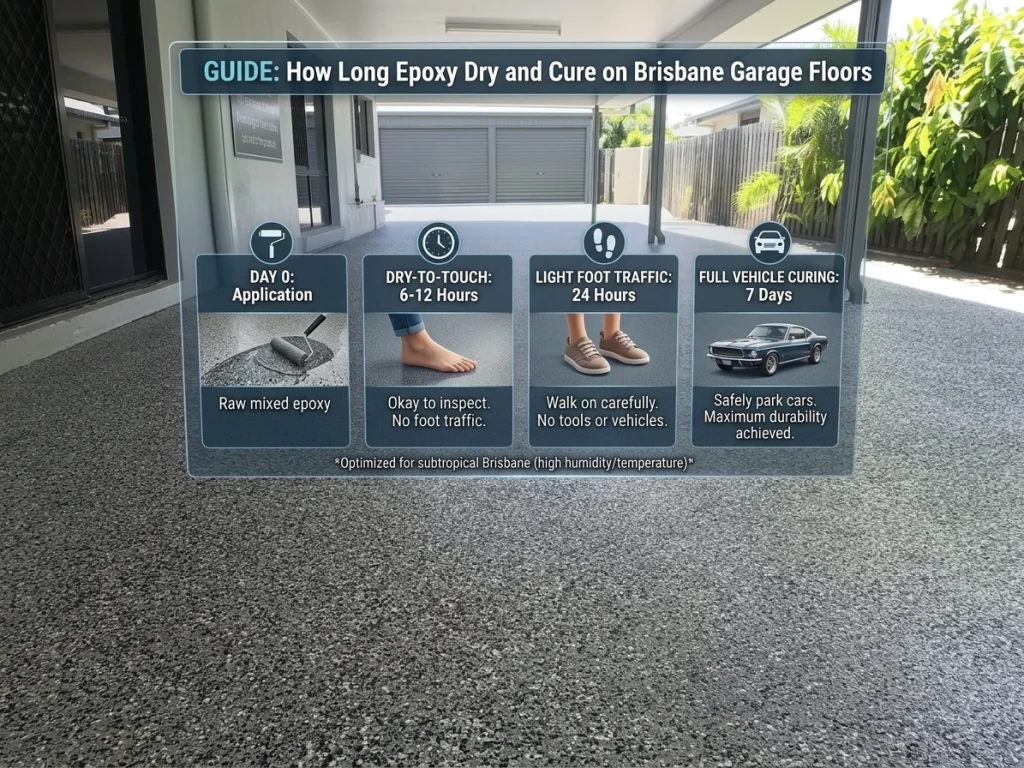
Epoxy cure progresses through five stages: touch-dry at 4 to 8 hours, light foot traffic at 16 to 24 hours, full domestic use at 48 to 72 hours, vehicle access at 5 to 7 days, and full chemical cure at 7 to 30 days. Brisbane’s summer heat accelerates early stages but shortens pot life, while humidity above 85 percent requires humidity-tolerant product specification to prevent amine blushing. Epoxy Brisbane manages all cure scheduling on every installation as part of the professional service.
Why Epoxy Has Multiple Dry Times, Not One
Asking how long epoxy takes to dry is similar to asking how long a building takes to build. The answer depends on which milestone in the process is being measured. Epoxy does not simply dry in the way paint dries: paint is wet because of its solvent or water carrier, and it becomes dry when that carrier evaporates. Professional two-part epoxy cures by a chemical cross-linking reaction between the resin and hardener components that was initiated at the moment of mixing. This reaction progresses continuously from mixing through to full cure, producing a polymer that gains hardness and chemical resistance progressively rather than transitioning from wet to dry in a single step.
Each stage of this progressive cure represents a different physical state of the polymer and a different level of safe use. Understanding which stage corresponds to which activity allows Brisbane property owners and facility managers to plan access to the space during and after installation without either waiting unnecessarily long or risking damage by using the floor too early.
Stage One: Touch-Dry (Four to Eight Hours)
Touch-dry is reached when the surface of the topcoat no longer transfers to a finger pressed lightly against it. The surface has formed a skin as the outer layer of the curing polymer has progressed far enough in the cross-linking reaction to feel firm. This stage is reached within four to eight hours of the final coat application in Brisbane’s typical autumn and spring conditions at 20 to 25 degrees Celsius ambient temperature.
Touch-dry does not mean the floor is ready to use. Beneath the dry surface skin, the polymer is still mid-cure and remains soft enough to be indented by point pressure, scuffed by footwear, and contaminated by any material pressed against it. Touch-dry is relevant primarily to the installer, who uses it to judge when the next coat in a multi-layer system can be applied within the product’s recoat window. A floor that is touch-dry but has not reached the next stage should not be walked on, kneeled on, or have any objects placed on it.
Stage Two: Light Foot Traffic (16 to 24 Hours)
Light foot traffic safe means the cured polymer has achieved sufficient surface hardness to resist the pressure of a rubber-soled shoe under a normal walking step without indenting, scuffing, or leaving marks. In Brisbane’s typical autumn and spring conditions, this stage is reached 16 to 24 hours after the final topcoat application. At this stage, the installer can move back through the space to complete edge work or neighbouring areas, and the property owner can access the space briefly for essential purposes.
Light foot traffic does not mean normal residential use. Dragging furniture, carrying heavy loads, wearing rubber-soled work boots with metal toe reinforcement, or allowing pets to run across the surface at this stage can all produce marks or surface damage that cannot be reversed without topcoat remediation. The correct approach at this stage is bare feet or socked feet with soft pads placed at entry points, not rubber-soled footwear, and only the minimum necessary access.
Stage Three: Full Domestic Use (48 to 72 Hours)
Full domestic use safely means the floor can be walked on normally with any footwear without risk of surface damage, furniture can be moved back into the room using felt pads under legs, and light cleaning with a damp mop can be carried out. This stage is reached 48 to 72 hours after the final topcoat application in Brisbane’s typical installation conditions. At this stage, normal household access resumes.
Full domestic use does not mean vehicle access for a garage floor or exposure to harsh cleaning chemicals for any floor type. The polymer is still maturing its chemical resistance and load capacity properties during this period. Cleaning the new floor during the first 48 to 72 hours, if required, should use only clean water and a soft damp mop, not cleaning products, to avoid any chemical interaction with the still-maturing topcoat surface.
Stage Four: Vehicle Access (Five to Seven Days)
Vehicle access safe means the floor has reached sufficient polymer hardness and load capacity to withstand the point-load pressure of a vehicle tyre contact on the epoxy surface during parking manoeuvres. For a Brisbane garage epoxy flooring installation, this is the milestone that determines when the vehicle can be parked back in the garage. In Brisbane’s typical installation conditions, five to seven days after the final topcoat application is the standard guidance for vehicle access.
The risk of early vehicle access is hot tyre pickup: the still-maturing polymer surface can be softened by the heat of a vehicle tyre that has been driven on Brisbane’s warm summer roads, and the tyre can lift the topcoat from the surface during the cooling cycle. This produces circular or arc-shaped marks where the tyre contacts the floor that are permanent and cannot be removed without topcoat remediation. For Brisbane summer installations where the vehicle tyres arrive particularly warm after road driving in high temperatures, waiting the full seven days rather than the minimum five is the conservative approach.
Stage Five: Full Chemical Cure (Seven to Thirty Days)
Full chemical cure is the point at which the cross-linking reaction between the resin and hardener components has completed to the maximum extent achievable at the installation conditions. At full cure, the polymer has reached its rated hardness, chemical resistance, adhesion strength to the substrate, and impact resistance. In Brisbane’s typical installation conditions, full chemical cure for professional two-part epoxy systems is reached between seven and thirty days after the final coat application, with most professional systems achieving functional full cure within seven to fourteen days.
Practical implications of full chemical cure: harsh cleaning chemicals that the floor’s product data sheet rates the system as resistant to should not be used until full cure has been reached. For Brisbane commercial kitchen flooring and food processing area installations where sanitising chemicals are used during normal operation, the facility should be scheduled to remain out of chemical cleaning service until the full cure date specified in the installation documentation has passed.
Cure time is a separate question from how long a finished epoxy floor lasts once fully cured. For lifespan expectations rather than initial cure scheduling, see how long do epoxy floors last.
How Brisbane’s Climate Affects Each Cure Stage
Brisbane’s Summer Heat: Shorter Pot Life, Variable Cure Speed
Brisbane’s summer ambient temperatures in the 28 to 35 degree range affect the two-part epoxy cure process in both the installation and the post-installation period. During installation, higher temperatures accelerate the chemical reaction between the resin and hardener components, shortening the pot life of the mixed product from the 20 to 30 minutes typical in spring and autumn conditions to 15 to 20 minutes in summer. This requires more experienced installation crews working in coordinated smaller batches to avoid mixing more product than can be applied within the shortened working window.
After installation, Brisbane’s summer heat also accelerates the initial cure stages: touch-dry and light foot traffic stages are reached slightly sooner in hot conditions than in moderate temperatures. However, the acceleration of cure in high heat does not proportionally reduce the total cure timeline for vehicle access and full chemical cure, as these later stages are governed more by the completeness of the cross-linking reaction than by its speed.
Brisbane’s Monsoon Humidity: Amine Blushing Risk
Brisbane’s wet season from December to February, when ambient humidity regularly exceeds 80 to 85 percent, creates a specific cure quality risk called amine blushing. Amine hardeners in two-part epoxy systems can react with atmospheric moisture during the cure period under very high humidity conditions, producing a milky or waxy film on the cured surface called amine blush. Amine blush reduces the adhesion of subsequent coats applied over it and produces a visible surface defect in the finished floor.
Professional Brisbane installers address this risk by specifying humidity-tolerant amine hardeners in the body coat formulation for summer installations, scheduling application to avoid the highest-humidity periods of the day, and monitoring relative humidity during the installation and initial cure period. If amine blush forms on a partially cured coat before the next coat is applied, the affected surface must be cleaned and lightly prepared before the subsequent coat proceeds. Managing this risk is a professional installation skill that is one of the reasons that summer epoxy installations in Brisbane require more experienced crews than autumn and spring installations.
What Happens When You Use an Epoxy Floor Too Early
Using an epoxy floor before it has reached the appropriate cure stage for the activity produces damage that ranges from minor surface marks to significant structural delamination depending on how early the use occurs and what load is applied.
Walking on a touch-dry but not light-traffic-ready floor with rubber-soled footwear produces scuff marks and surface indentation that are permanent in the cured polymer. These marks are most visible on high-gloss solid colour or metallic finishes where any surface variation catches the light. Furniture placed on a floor before it reaches the full domestic use stage leaves permanent indentations at the contact points.
Vehicle access before the five to seven day milestone produces the hot tyre pickup described above, which is one of the most damaging and visible failure modes of premature vehicle access. Vehicle tyre marks from early access cannot be removed by cleaning and require professional topcoat remediation to resolve. To protect the epoxy flooring durability and visual quality of a new Brisbane installation, following the installer’s specific cure stage guidance is as important as any other aspect of the installation process.
Frequently Asked Questions
- How long does epoxy take to dry enough to walk on in Brisbane?
In Brisbane’s typical autumn and spring conditions at 20 to 25 degrees Celsius, a professional two-part epoxy floor is safe for light foot traffic 16 to 24 hours after the final topcoat application. In Brisbane’s summer at higher temperatures, this milestone may be reached slightly sooner. In cooler winter conditions where temperatures drop below 15 degrees, the timeline extends and professional products may require up to 36 to 48 hours before light foot traffic is safe. The installer’s specific product data sheet guidance takes precedence over general timelines.
- Can I speed up epoxy drying in my Brisbane garage?
Increasing ambient temperature in the garage during the initial cure period accelerates the cross-linking reaction and can reduce the time to reach light foot traffic safe. A portable space heater that raises the garage temperature from 20 to 25 degrees accelerates early cure stages. However, excessive heat can cause uneven cure in different areas of the floor if air circulation is not adequate. Improving ventilation during cure reduces the humidity in the curing environment, which benefits cure quality in Brisbane’s humid conditions. Do not apply heat sources directly to the epoxy surface. Follow the installer’s specific recommendations for your product system.
- Is the epoxy floor dry enough for furniture after 24 hours in Brisbane?
After 24 hours in typical Brisbane conditions, an epoxy floor is at or approaching the light foot traffic stage, which allows careful walking in soft footwear. Furniture should not be moved back onto the floor until the floor reaches the full domestic use stage at 48 to 72 hours. When furniture is returned, all legs must have felt pads attached before contact with the epoxy surface. Do not drag furniture across a newly installed epoxy floor at any stage during the cure period: sliding contact applies concentrated lateral force that can scuff even a fully cured surface and is particularly damaging on a still-curing floor.
- When can I park my car on a new Brisbane garage epoxy floor?
The standard guidance for vehicle access on a professionally installed Brisbane garage epoxy floor is five to seven days after the final topcoat application. In Brisbane’s summer conditions where vehicle tyres arrive warm from road driving, waiting the full seven days rather than the minimum five reduces the hot tyre pickup risk during the critical first vehicle parking event. The first parking event is always the highest risk: if the floor has not fully cured, the combination of tyre heat and tyre weight creates the conditions for hot tyre pickup that subsequent parkings, once the floor has passed the vehicle-safe milestone, do not present.
Let Your Brisbane Epoxy Floor Cure Correctly
Following the correct cure timeline for each stage of a Brisbane epoxy floor installation protects the investment in the floor and the quality of the result across its full service life. Epoxy Brisbane provides specific cure stage guidance for every installation and monitors Brisbane climate conditions to schedule installations in the most appropriate seasonal window. QBCC-licensed. Call 1300 321 433 or get in touch with the Epoxy Brisbane team to discuss scheduling and cure planning for your Brisbane epoxy floor project.
Key Takeaways
- Full chemical cure for chemical resistance takes 7 to 30 days. Harsh cleaning chemicals should not be used until after this milestone.
- Epoxy has five distinct cure stages: touch-dry (4 to 8 hrs), light foot traffic (16 to 24 hrs), full domestic use (48 to 72 hrs), vehicle access (5 to 7 days), full chemical cure (7 to 30 days).
- Touch-dry means the surface skin has formed, not that the floor is safe to use. The polymer beneath is still soft.
- Brisbane summer heat shortens pot life to 15 to 20 minutes and accelerates early cure stages.
- Brisbane monsoon humidity above 85 percent creates amine blushing risk. Professional installers specify humidity-tolerant hardeners for summer installations.
- Hot tyre pickup from early vehicle access is the most damaging and visible consequence of insufficient cure time on a Brisbane garage floor.
