

Table of Contents
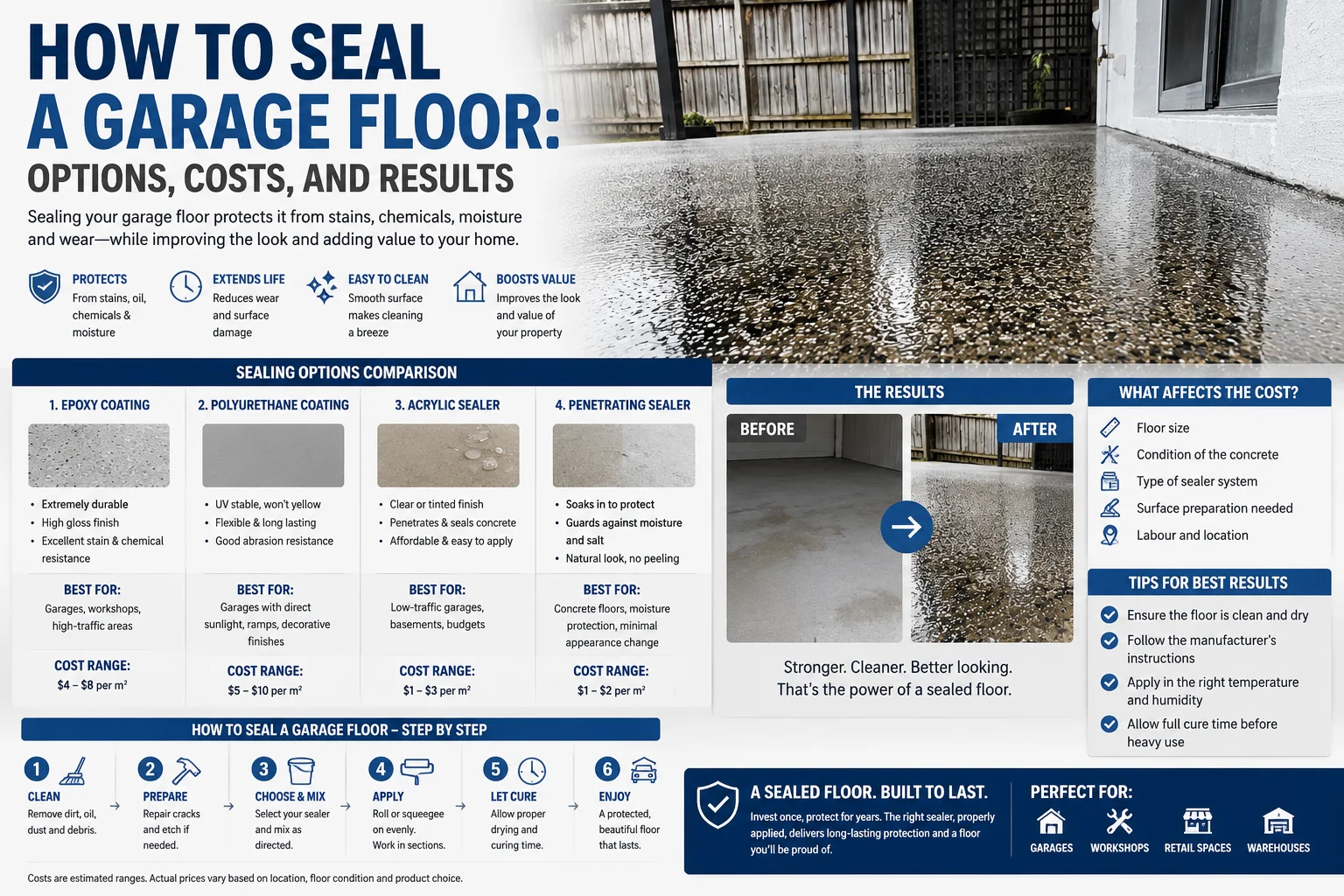
Sealing a garage floor protects concrete from staining, moisture, and surface wear, but the type of sealer you choose determines how long that protection lasts and how good the floor looks while delivering it. This guide compares the main garage floor sealing options available in Brisbane, from basic penetrating sealers through to full epoxy coating systems, so you can make an informed decision before spending a dollar.
Why Sealing a Garage Floor Matters
An unsealed concrete garage floor is porous by nature. It absorbs oil, fuel, tyre marks, and cleaning chemicals directly into the surface, staining permanently and degrading over time. Moisture from the slab itself can also create damp conditions that promote mold growth and accelerate the deterioration of anything stored on or near the floor.
Sealing the garage floor addresses all of these issues by creating a barrier between the concrete and the environment it operates in. The difference between a sealed and unsealed garage floor is immediately visible in how it looks, and becomes even more significant over time in how it performs and how easy it is to keep clean.
The right sealing solution depends on how the garage is used, what performance outcomes you are prioritising, and how long you need the result to last. The garage epoxy flooring options Epoxy Brisbane provides across Brisbane cover the full range from surface coating through to high-performance industrial-grade systems.
Types of Garage Floor Sealers
Penetrating Sealers
Penetrating sealers, also called impregnating sealers, work by soaking into the concrete rather than forming a film on top of it. They react chemically with the concrete to block pores and repel moisture, oil, and contaminants at a subsurface level. The surface appearance after application is minimal – the concrete looks the same or slightly darkened, without any sheen.
Penetrating sealers are durable and low-maintenance, typically lasting 5 to 10 years before reapplication is needed. They are a good baseline protection option for garages that prioritise function over appearance. Their primary limitation is that they do not significantly improve the visual quality of the floor or provide any surface hardness against abrasion and impact.
Acrylic Sealers
Acrylic sealers form a thin film on the surface of the concrete, providing basic protection against moisture and light staining. They are available in gloss and matte finishes and are one of the most affordable sealing options on the market. Application is straightforward, and the product is available through most hardware stores as a DIY product.
The trade-off is durability. Acrylic sealers wear relatively quickly under vehicle traffic and chemical exposure, typically requiring reapplication every one to three years. For a working garage, this maintenance cycle is a practical consideration that narrows the cost advantage over more durable options.
Polyurethane Sealers
Polyurethane sealers offer greater hardness and chemical resistance than acrylic products. They form a thicker protective film that stands up better to vehicle traffic, tire scuffing, and the chemical exposure typical of a working garage environment. Available in water-based and solvent-based formulations, polyurethane sealers deliver a more durable result than acrylic at a higher upfront cost.
Lifespan in a residential garage environment is typically 3 to 5 years with normal use. They are a step up from acrylic in performance but fall short of the durability and visual quality that a full epoxy coating system delivers.
Epoxy Coating Systems
Epoxy coating is the highest-performance option for sealing and protecting a garage floor. Unlike the sealer types above, a professional epoxy system is a multi-coat application that bonds chemically to the concrete substrate, creating a surface that is structurally integrated with the slab rather than a film resting on top of it.
The result is a floor that resists oil, fuel, chemical spills, heavy vehicle loading, and abrasion at a level that no surface sealer can match. A professionally installed epoxy coating on a properly prepared slab typically lasts 10 to 20 years in a residential garage. The residential floor area and commercial projects Epoxy Brisbane handles regularly demonstrate the performance difference between a coated floor and a sealed one over time.
Preparing a Garage Floor for Sealing
Regardless of which sealer or coating option you choose, the condition and preparation of the concrete surface determines how long any product will last. This is the step most DIY applications underestimate, and the primary reason garage floor sealers fail prematurely.
Cleaning and Degreasing
Oil and grease contamination must be fully removed before any sealer or coating is applied. Penetrating sealers and epoxy systems cannot bond through contamination. A degreasing agent is applied and worked into the surface, followed by thorough rinsing and drying. For heavily contaminated floors, this process may need to be repeated.
Crack and Surface Repair
Visible cracks, spalling, and surface damage should be filled and repaired before sealing. Applying a sealer over existing cracks does not prevent them from growing or showing through the finished surface. Repair products need adequate cure time before the sealer or coating is applied over them.
Surface Profiling for Epoxy Systems
For epoxy coating systems specifically, the concrete surface must be mechanically abraded using diamond grinding equipment to create a surface profile the epoxy can grip. This step is not required for penetrating sealers but is non-negotiable for any film-forming coating that needs to bond to the substrate. The concrete resurfacing process that precedes a professional epoxy installation covers all of these preparation steps as a standard part of the service.
Moisture Testing
Moisture vapour rising through the slab is one of the most common causes of sealer and coating failure. A moisture test before application identifies whether the slab has elevated vapour transmission that needs to be addressed with a moisture-tolerant primer or barrier system before any coating goes down.
Epoxy Coating vs. Sealer: The Key Differences
Understanding where epoxy coating sits relative to conventional sealers makes the decision clearer. Surface sealers – penetrating, acrylic, and polyurethane – are applied to the top of the concrete with minimal preparation and provide a degree of protection that is appropriate for low-demand environments. They are accessible, relatively affordable upfront, and within the reach of a competent DIY applicator.
Epoxy coating requires professional-grade preparation, product, and application technique. The preparation investment is higher, the product cost is higher, and the installation requires specialist equipment. In return, the performance outcome is in a different category: a floor that handles vehicle loading, chemical spills, and heavy use for a decade or more without significant maintenance.
For a garage used for vehicle parking, mechanical work, or storage of chemicals and equipment, the long-term economics of a professional epoxy system consistently outperform repeated sealer applications over the same period. The decorative options available through systems like flake designs also produce a finished floor that sealers simply cannot replicate in appearance.
According to Standards Australia, the performance of any floor finish is directly tied to the preparation of the substrate and the specification of the product system for the intended use environment. This is as true for a residential garage sealer as it is for a warehouse epoxy flooring installation.
How Long Each Option Lasts in a Brisbane Garage
Brisbane’s subtropical climate introduces specific considerations for garage floor sealing. High summer humidity, temperature variation between seasons, and the UV exposure common in Queensland affect how different products perform over time.
Penetrating sealers perform consistently in Brisbane’s climate and are not significantly affected by UV or humidity. Acrylic sealers are more susceptible to UV degradation and can chalk or peel in areas exposed to direct sunlight. Polyurethane sealers perform better than acrylics in UV-exposed areas but still degrade faster in Queensland conditions than in cooler climates.
Epoxy systems specified with a UV-stable polyurethane or polyaspartic top coat perform reliably in Brisbane’s conditions and maintain their appearance over a much longer service life than any surface sealer. The workshop flooring coating and residential installations Epoxy Brisbane carries out across Brisbane are specified with Brisbane’s climate conditions in mind as a standard part of product selection.
According to the Australian Building Codes Board, floor finishes in residential and commercial buildings must be specified and applied to meet the performance demands of the climate and use environment. In Queensland, this means UV resistance and moisture management are baseline considerations, not optional extras.
Cost Comparison: Sealing vs. Epoxy Coating
The upfront cost of a penetrating or acrylic sealer is lower than a professional epoxy installation. For a standard single-car garage, the gap between a DIY sealer application and a professional epoxy coating is real.
Where the comparison shifts is over time. A DIY acrylic sealer applied every two years accumulates cost and effort across a decade that, when totalled, often exceeds the cost of a single professional epoxy installation. A penetrating sealer requires less frequent reapplication but provides a lower level of protection that may not be adequate for a working garage.
For property owners who use the garage actively – vehicle maintenance, storage of chemicals, heavy equipment – the cost-per-year of a professional epoxy system is consistently lower than cycling through sealer applications, and the performance outcome is incomparably better. Completed projects in the Epoxy Brisbane project gallery show the visual and functional difference that a professional coating delivers against a basic sealed concrete surface.
Which Option Is Right for Your Brisbane Garage?
The right sealing solution depends on three factors: how the garage is used, how long you need the protection to last, and what visual outcome you want from the floor.
For light use, infrequent vehicle access, and a primarily cosmetic goal, a penetrating or polyurethane sealer is a practical and cost-effective starting point. For a working garage with regular vehicle traffic, oil and chemical exposure, and a desire for a floor that looks as good as it performs, a professional epoxy coating is the only option that delivers reliably over the long term.
According to the Queensland Building and Construction Commission, engaging a licensed contractor for flooring work meets professional workmanship standards for the preparation and application. For an epoxy coating, licensing and experience make a measurable difference in the quality and longevity of the result. Commercial and industrial garages requiring heavy-duty performance will find the full specification options covered under the industrial environment coating system service.
Many homeowners tackle a garage upgrade as a complete project rather than floor-only, and wall and trim finishes are usually part of that scope. Epoxy Brisbane’s painting services extend the same professional finish standard to those surrounding surfaces, so the floor and the rest of the space are brought up together.
Frequently Asked Questions
- Is sealing a garage floor worth it?
Yes, for any garage used regularly. An unsealed concrete floor absorbs stains permanently and degrades faster than a sealed or coated surface. The floor will perform better, last longer, and be significantly easier to clean with any quality sealer applied correctly. The question is which product delivers the level of protection your specific garage requires.
- Can I seal a garage floor myself?
Penetrating sealers and acrylic sealers are within the reach of a careful DIY applicator, provided the surface preparation is done correctly. Epoxy coating systems require professional equipment, product knowledge, and application techniques that are difficult to replicate with hardware store kits. A DIY epoxy attempt that skips diamond grinding and uses inadequate primers will fail significantly faster than a professionally installed system.
- How long does a garage floor sealer last?
Acrylic sealers typically last one to three years in a working garage. Polyurethane sealers last three to five years. Penetrating sealers last five to ten years. A professionally installed epoxy coating system lasts 10 to 20 years on a properly prepared slab. The gap in service life is the primary argument for investing in a professional coating rather than cycling through repeated sealer applications.
- Does sealing a garage floor prevent oil stains?
A quality sealer significantly reduces oil penetration into the concrete, but the effectiveness depends on the product and the application quality. Penetrating sealers block oil at the pore level. Surface sealers create a film that oil sits on rather than soaking through, making cleanup easier. Epoxy coatings provide the highest level of oil resistance – spills wipe up without leaving any trace on the surface.
- Do I need to grind the concrete before sealing a garage floor?
Grinding is required for epoxy coating systems and is strongly recommended for polyurethane sealers applied to a previously sealed or contaminated surface. Penetrating sealers and acrylic sealers can be applied to cleaned and degreased concrete without mechanical abrasion, though better results are achieved on profiled surfaces. Your installer or product supplier should advise the appropriate preparation for the specific product being used.
- What is the best garage floor sealer for Brisbane’s climate?
For Brisbane’s combination of UV exposure, humidity, and temperature variation, a UV-stable polyurethane sealer is the minimum recommendation for surface sealers. For a long-term solution that handles Brisbane’s conditions and the demands of a working garage, a professionally installed epoxy system with a UV-stable polyaspartic top coat delivers the most reliable and durable outcome.
Ready to Properly Protect Your Garage Floor?
A site assessment is the fastest way to understand which sealing or coating solution suits your specific garage. The Epoxy Brisbane team works across residential and commercial properties throughout Brisbane and will give you an honest comparison of your options based on your floor’s condition and usage requirements.
Key Takeaways
- Sealing a garage floor is always worthwhile: Unsealed concrete absorbs stains permanently and degrades faster. Even a basic sealer extends the life of the concrete and makes the floor significantly easier to clean.
- Four main options exist: Penetrating sealers, acrylic sealers, polyurethane sealers, and epoxy coating systems each deliver different levels of protection, durability, and visual quality.
- Preparation determines performance: Degreasing, crack repair, and surface profiling before application are as important as the product itself. Poor preparation is the primary cause of premature failure.
- Epoxy coating outperforms sealers in working garages: A professional epoxy system lasts 10 to 20 years and handles vehicle loading, chemical exposure, and abrasion that surface sealers cannot withstand.
- Brisbane’s climate favours UV-stable products: UV exposure and summer humidity degrade acrylic sealers faster in Queensland than in cooler climates. Specify UV-stable products as a baseline.
- Long-term economics favour epoxy: Repeated sealer applications over ten years often cost more in total than a single professional epoxy installation, with significantly lower performance over the same period.
- A site assessment clarifies the right choice: The condition of your specific slab, contamination levels, and moisture readings all affect which product is appropriate for your garage.
