

Table of Contents
Tiles epoxy paint covers a range of products, from retail paint-grade coatings to professional two-part epoxy floor systems, and the product type, surface preparation, and tile condition all shape how the finished floor performs and how long it lasts. Brisbane homeowners and property managers weighing their options need to know the difference between a painted tile and a professionally coated one before choosing a direction. Epoxy Brisbane installs professional-grade two-part epoxy systems over correctly assessed and prepared tile floors across Greater Brisbane.
Why the Term Tiles Epoxy Paint Covers Very Different Products
The phrase tiles epoxy paint is used in Brisbane home renovation conversations to describe anything from a tin of specialist tile paint available at hardware stores to the professional two-part coating systems used by licensed flooring contractors. These products are not interchangeable. They differ in chemical composition, application requirements, performance characteristics, and longevity. Choosing the wrong product for your tile floor, or applying the right product without the correct preparation, produces a result that fails faster than expected.
At the retail end of the market, epoxy paint products marketed for tile applications are generally single-component formulations. They cure by solvent or water evaporation and produce a surface harder and more durable than standard wall paint but significantly softer and thinner than a true two-part epoxy floor system. These products are appropriate for low-traffic areas where the goal is a cosmetic refresh rather than a long-term floor coating.
At the professional end of the market, two-part epoxy systems are mixed immediately before application, triggering a chemical reaction that cures the product into a rigid polymer matrix. The surface produced by this process is categorically different in hardness, chemical resistance, and adhesion from any single-component paint. This is the product class used for garage floors, commercial kitchens, workshops, and any environment where the floor sees meaningful traffic and exposure.
What Tiles Epoxy Paint Can and Cannot Do
Understanding the realistic performance envelope of each product category helps Brisbane property owners choose the right approach for their situation.
A retail-grade epoxy paint applied to a tile floor can improve the appearance of ageing tiles, cover discolouration and surface staining, and provide a modest improvement in chemical resistance over untreated tile. It is relatively straightforward to apply, is available in a limited range of colours, and requires less preparation than a professional epoxy system. The limitations are that it is softer and more susceptible to chipping and peeling, particularly in garages, kitchens, and outdoor covered areas where exposure to traffic, heat, and chemicals is regular.
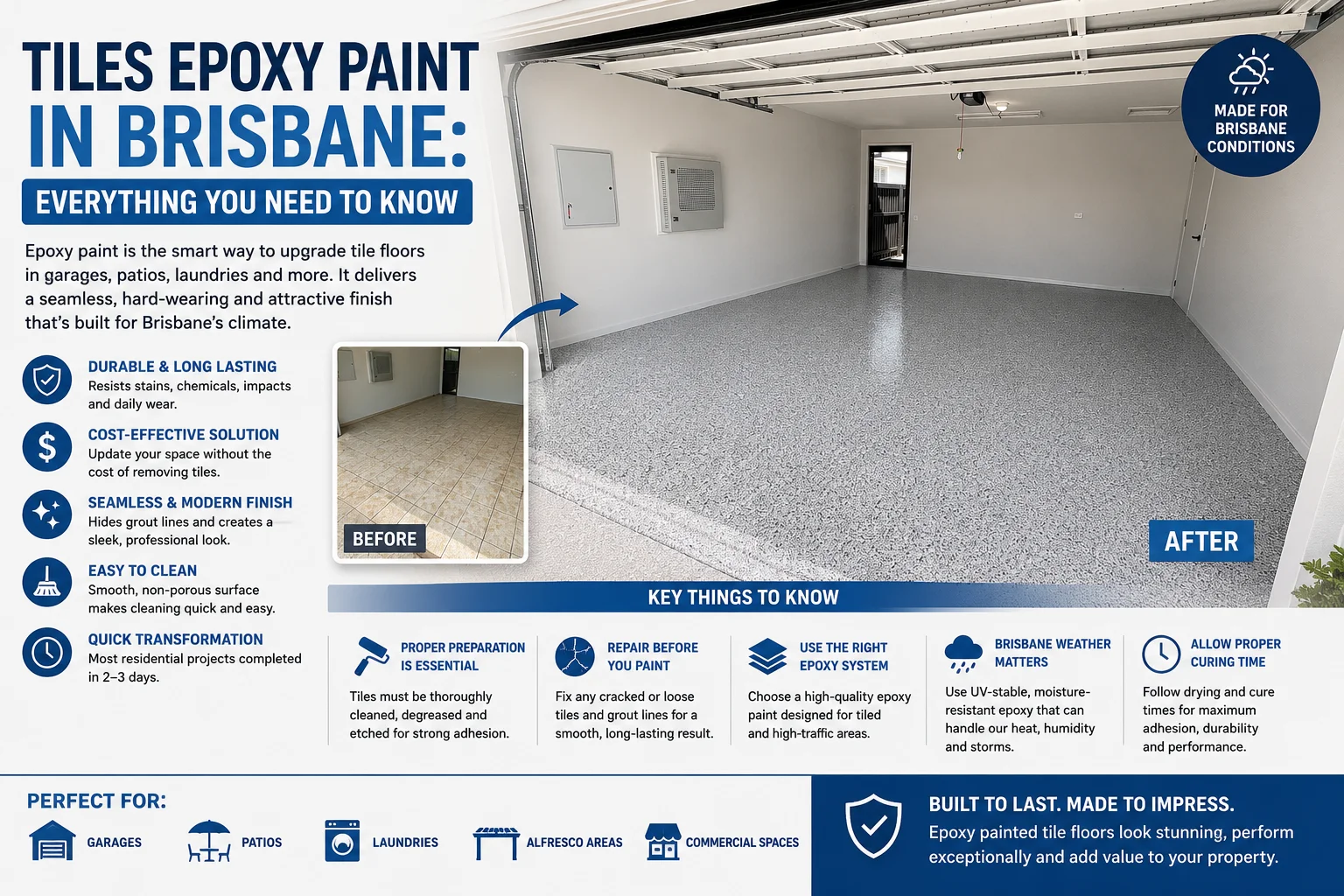
A professional two-part epoxy system applied to a correctly prepared tile floor produces a surface that handles vehicle traffic, dropped tools, chemical spills, and heavy foot traffic without significant deterioration. It provides a genuinely seamless finish that eliminates grout lines when preparation is done correctly. It lasts significantly longer than any paint product. The requirements are that the tile floor must pass a suitability assessment, the surface must be professionally prepared including diamond grinding and specialist primer, and the installation must be carried out by a qualified applicator. WorkSafe Queensland’s guidance on floor and ground surfaces identifies slip resistance and surface integrity as critical performance requirements for coated floors, and only a correctly specified two-part system reliably meets these standards in demanding environments.
Tiles That Can Accept Epoxy Paint or Coating
Ceramic tiles in sound condition are the most common candidate for any epoxy application in Brisbane residential and commercial properties. The glazed ceramic surface requires mechanical preparation for adhesion, but ceramic responds well to grinding and accepts primer reliably when the glaze is fully removed.
Porcelain tiles are suitable candidates for professional epoxy systems when the tiles are fully bonded and the surface is prepared correctly. Porcelain is harder than ceramic and requires more aggressive grinding, but the preparation outcome is reliable on intact, well-bonded porcelain.
Outdoor tiles present additional considerations. Moisture management, UV exposure, and substrate movement in outdoor concrete or pavement substrates affect the performance of any epoxy or paint product applied over outdoor tiles in Brisbane’s climate. Outdoor epoxy flooring assessments for tile surfaces include evaluation of drainage, moisture, and substrate stability before any product is recommended.
Tiles with cracks, loose adhesion, or heavily deteriorated grout are not suitable candidates for any epoxy paint or coating application until those underlying problems are addressed. A surface failure beneath an epoxy application will always transfer through to the coating above it.
Preparation: The Step That Determines Whether Tiles Epoxy Paint Works
No epoxy paint or coating product, regardless of its quality or price, will adhere reliably to a tile surface that has not been mechanically prepared. Tile glaze is a fired ceramic surface specifically designed to resist penetration, and epoxy cannot form a bond with it without the glaze being removed through grinding.
For retail paint products applied by homeowners, preparation typically involves thorough cleaning, light sanding with an abrasive pad, and application of a bonding primer. This preparation level is sufficient for cosmetic refresh applications in low-traffic areas but is not adequate for floors that will experience significant traffic or chemical exposure.
For professional two-part epoxy systems, preparation involves diamond grinding to remove the glaze completely and create a defined surface profile, grout line filling and levelling, and application of a specialist primer formulated for non-porous substrates. For floors with heavily contaminated grout, shot blasting may be incorporated into the preparation scope. This preparation level is required for the coating to perform at its rated specification and lifespan.
The Brisbane City Council’s Industry Environmental Guide for Surface Coating sets out the environmental management requirements for surface coating work in Brisbane, which licensed professional contractors manage as part of any commercial project scope.
When to Call a Professional for Your Brisbane Tile Floor
A retail epoxy paint product is a reasonable approach for a low-traffic area where the goal is a cosmetic improvement and the tiles are in sound condition. A laundry room, a storage area, or an infrequently used covered porch may be suitable applications for a retail product applied with appropriate preparation.
A professional installation is the right choice for any tile floor that will see regular vehicle traffic, food preparation activity, industrial or chemical exposure, or any other demanding use condition. Garage floors, commercial kitchen floors, workshop flooring, and retail or hospitality spaces all require the performance of a properly installed two-part epoxy system, not a paint product.
The distinction is also relevant for warranty and compliance purposes. A QBCC-licensed installation is backed by a workmanship warranty. A retail paint application is not. In commercial environments where flooring is subject to regulatory inspection, only a professional installation that meets the applicable standards will satisfy compliance requirements. The QBCC’s guidance on finding a licensed contractor explains how to verify a flooring contractor’s licence status before engaging them for any installation.
Choosing the Right Approach for Your Brisbane Property
The right tile epoxy paint approach depends on your tile condition, your environment, your use requirements, and your timeline. For residential applications in lower-traffic spaces, a retail product with adequate preparation may be a practical short-term solution. For any environment where the floor needs to perform reliably over years rather than months, a professional two-part epoxy system installed over a correctly assessed and prepared tile floor is the appropriate choice.
Epoxy Brisbane assesses tile floors across residential, commercial, and industrial properties throughout Greater Brisbane and the Moreton Bay region and holds a current QBCC licence. The business is a Moreton Bay Local Business Award Finalist, reflecting the standard it maintains across every installation. To discuss your tile floor and the options that suit your situation, call 1300 321 433 or view the project gallery for completed installations in similar environments.
Frequently Asked Questions
1. What is the difference between epoxy paint and epoxy floor coating?
Tiles epoxy paint is generally a single-component, paint-grade product that cures by evaporation and produces a surface similar to a durable paint. An epoxy floor coating is a two-part system of resin and hardener that cures by chemical reaction into a rigid polymer. The two-part system is significantly harder, thicker, more chemically resistant, and longer-lasting. The appropriate product depends on the use environment and the level of performance required. Our epoxy flooring durability guide covers how performance holds across different substrates and environments.
2. Can I apply epoxy paint to my Brisbane garage tile floor myself?
Retail epoxy paint products are available for homeowner application. However, the preparation required for any epoxy product on glazed tiles, including mechanical deglossing and specialist primer, is more involved than most homeowners anticipate. Without correct preparation, any epoxy paint product will peel or delaminate within months in a garage environment. If the garage floor sees regular vehicle traffic, tool use, and chemical exposure, a professional two-part epoxy system with correct preparation will produce a result that justifies the investment relative to a retail product that requires reapplication. See our garage epoxy flooring page for more on what a professional installation involves.
3. How long does epoxy paint last on tile floors in Brisbane?
A retail epoxy paint product applied with adequate preparation to a low-traffic tile floor may last two to four years in Brisbane conditions before it requires reapplication. A professional two-part epoxy system installed over a correctly prepared tile floor with specialist primer typically lasts ten to fifteen years in residential environments and seven to ten years in commercial spaces. Brisbane’s humidity and temperature affect both product performance and cure times, and UV-stable topcoats are recommended for any exposure to sunlight. For a detailed breakdown of lifespan factors, visit our how long epoxy flooring lasts guide.
4. Does epoxy paint or epoxy coating hide tile grout lines?
A retail epoxy paint product applied over existing tile grout lines will generally not conceal them. The paint fills the grout line partially but does not level it flush with the tile surface, so the grout pattern remains visible in the finished coating. A professional two-part epoxy system applied over a correctly levelled substrate with grout lines filled flush and ground smooth will produce a seamless surface where grout lines are not visible. Completed examples are available in the project gallery.
5. What preparation does tile floor epoxy paint require?
Any epoxy product applied to a tile floor requires at minimum the removal of the tile glaze through sanding or grinding, thorough cleaning to remove all oils, sealers, and contaminants, and application of a bonding primer appropriate for non-porous surfaces. Professional installations also include grout line filling and levelling, and specialist primer formulated for tile substrates. Skipping any of these steps is the primary cause of premature coating failure on tile floors. For floors where full tile removal is necessary before coating, concrete resurfacing prepares the substrate to the correct standard.
6. Are there specific epoxy products for bathroom tile floors in Brisbane?
Yes. Bathroom tile floor applications require products that perform in a consistently wet, humid environment and that provide reliable slip resistance. A non-slip aggregate in the topcoat is required for safe use in any wet area. Moisture assessment of the substrate beneath bathroom tiles is also important before any coating is applied, as moisture migrating through grout lines can cause delamination of any epoxy product regardless of preparation quality. The residential flooring team assesses bathroom tile floors individually to confirm suitability and specify the correct product system for that environment.
The Right Tiles Epoxy Paint Decision for Your Brisbane Floor
Whether you are considering a retail product for a low-traffic space or a professional installation for a demanding environment, the decision on tiles epoxy paint comes down to what you need the floor to do and how long you need it to last. Epoxy Brisbane provides professional assessments, QBCC-licensed installation, and honest advice on the right approach for every tile floor across Greater Brisbane and the Moreton Bay region. Call 1300 321 433 or reach the team through the Epoxy Brisbane contact form to arrange a site assessment.
Key Takeaways
- Tiles epoxy paint covers a range from retail paint-grade products to professional two-part epoxy floor systems. These are not interchangeable.
- Retail epoxy paint suits low-traffic cosmetic refresh applications. Professional two-part systems suit garages, kitchens, workshops, and commercial spaces.
- Both product types require tile glaze removal. Professional installations additionally require grout levelling and specialist non-porous primer.
- Grout lines remain visible under retail paint. They are concealed under a professional epoxy system when preparation is done correctly.
- Brisbane’s humidity and UV intensity affect product performance. UV-stable topcoats are required for any outdoor or sunlight-exposed tile floor.
- Professional installations carry QBCC-licensed workmanship. Retail applications do not have equivalent warranty or compliance backing.
