

Table of Contents
Concrete floor preparation is the process of mechanically profiling and cleaning a concrete slab before a coating, sealer, or resurfacing system is applied. In Brisbane, proper surface preparation by diamond grinding or shot blasting is the single most important factor in determining whether an epoxy coating bonds correctly and performs for its intended service life. Epoxy Brisbane carries out full concrete surface preparation across Greater Brisbane for residential, commercial, and industrial flooring projects.
What Is Concrete Floor Preparation and Why Does It Determine Coating Performance?
Concrete floor preparation is the mechanical or chemical process of treating a concrete slab’s surface to make it suitable for accepting a coating, sealer, overlay, or adhesive. Without adequate preparation, even the highest-quality epoxy flooring system will fail. The coating may appear to bond initially but will delaminate under traffic, moisture movement, or thermal expansion within months of installation.
The reason preparation is so critical is that concrete surfaces are rarely clean or structurally consistent at the level an epoxy primer needs to bond. New slabs have a surface latitude layer, a weak, fine-grained layer that forms as the concrete cures and bleeding water rises to the surface. Old slabs accumulate contamination from oils, fuels, cleaning chemicals, previous coatings, and adhesives. Both conditions prevent a coating from bonding directly to the concrete structure below.
Surface preparation removes these barriers and creates a clean, profiled concrete surface with the correct anchor texture for the primer to penetrate, bond to, and build a mechanical and chemical connection with. The preparation method, profile depth, and cleanliness standard required all depend on the coating system being applied and the condition of the substrate.
What Methods Does Epoxy Brisbane Use for Concrete Surface Preparation?
Epoxy Brisbane uses two primary mechanical preparation methods, selected based on the project size, the substrate condition, the coating system being applied, and the access constraints of the site.
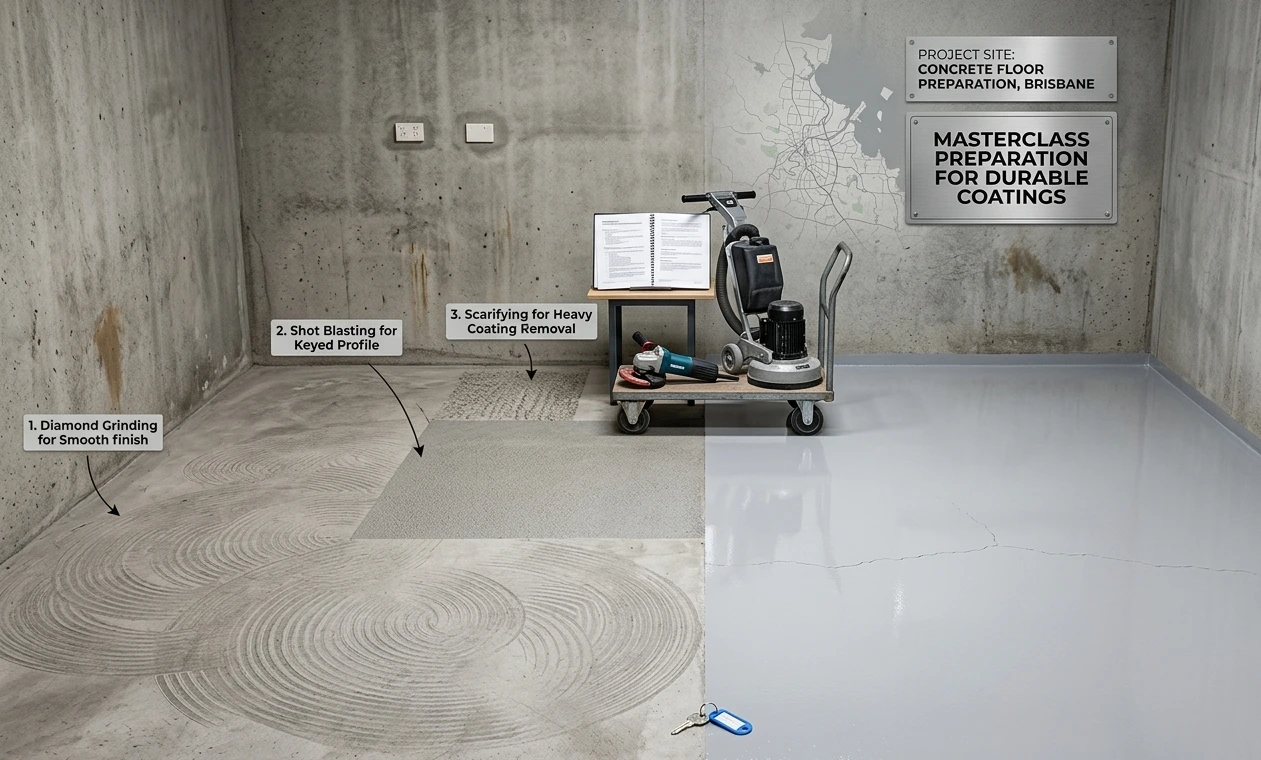
Diamond grinding is the standard preparation method for most residential and commercial flooring projects. A multi-head diamond grinding machine passes over the concrete surface using industrial diamond segments to abrade the surface to the correct profile. Diamond grinding is well suited to garage floors, commercial kitchens, workshops, and any area where precise control of the surface profile is needed or where the surrounding space limits the use of heavier equipment.
Shot blasting is the preferred method for large open warehouse floors and industrial facilities. A shot blasting machine propels steel shot at high velocity across the concrete surface, removing laitance, contamination, and surface weakness while leaving a consistent anchor profile across the entire area. Shot blasting is faster than diamond grinding for large areas and produces a uniform surface texture across the full floor area without the lap marks that can occur when grinding with a machine on a large site.
For localised defects, contaminated zones, or areas with existing coatings in good condition, Epoxy Brisbane may use hand-held grinders, scarifiers, or chemical decontamination treatments as part of the overall preparation scope. The full preparation method is determined during the site assessment, not assumed in advance.
What Surface Profile Is Required Before Applying an Epoxy Coating?
The surface profile required for a concrete floor before applying an epoxy coating is defined by the Concrete Surface Profile scale, published by the International Concrete Repair Institute (ICRI). This scale runs from CSP 1, a very light brush blast or acid etch, to CSP 10, a heavily scarified or shot blasted surface with deep aggregate exposure.
For most standard epoxy floor coatings applied in Brisbane residential and commercial environments, a CSP 2 to CSP 3 profile is appropriate. This is typically achieved by light to medium diamond grinding. For high-build industrial epoxy systems or polyurethane overlays applied in heavy-use industrial environments, a CSP 3 to CSP 4 profile may be required to provide the mechanical tooth the coating system needs to bond at the correct depth.
Epoxy Brisbane selects the preparation method and equipment to achieve the specific surface profile required by the coating product manufacturer. Applying a coating over an under-prepared surface voids the product warranty and significantly increases the risk of early delamination under traffic.
How Is Contaminated Concrete Treated Before Coating?
Contaminated concrete is one of the most common causes of epoxy floor coating failure on existing floors. Oil, fuel, hydraulic fluid, and chemical contamination that has penetrated the concrete over years of use cannot be removed by grinding alone. The contamination must be drawn out of the concrete pores before any mechanical profiling can expose clean concrete for the coating to bond to.
Epoxy Brisbane uses degreasing treatments and, where required, absorptive compounds applied to the contaminated areas and allowed to dwell and draw contamination from the slab. After treatment, the area is cleaned and the effectiveness of decontamination is assessed before grinding proceeds. In severely contaminated areas, this process may need to be repeated before the concrete is ready for a coating.
Assessing the degree of contamination is part of the site inspection Epoxy Brisbane carries out before quoting any floor coating project. Floors that appear clean at surface level may have significant sub-surface contamination from years of use, and this affects the preparation scope, the product selection, and the project timeline.
Does Concrete Moisture Affect Floor Preparation and Coating Adhesion?
Moisture in the concrete slab is a critical factor in both the preparation process and the performance of the coating applied after preparation. Excess moisture in the slab can cause solvent-based primers to blister, water-based systems to lose adhesion, and moisture vapour transmission after installation to cause delamination even in coatings that bonded correctly at the time of application.
Epoxy Brisbane carries out moisture testing on every project before specifying a coating system. Where the slab moisture content exceeds the product’s specified maximum, either a moisture-tolerant primer system is selected, or the project is scheduled to allow the slab to dry to an acceptable level. In cases where hydrostatic pressure from below the slab is the source of moisture, this must be addressed at the source before a surface coating can be reliably applied.
For concrete resurfacing projects, moisture management is equally important. An overlay or resurfacer applied over a wet slab will debond and fail within weeks, regardless of how well the surface was mechanically prepared.
What Happens If Concrete Preparation Is Skipped or Inadequate?
Skipping or under-specifying concrete floor preparation is the most common reason epoxy floor coatings fail in Brisbane. A coating applied over unground concrete, contaminated surfaces, or latitude-covered new slabs will not bond mechanically to the concrete and relies on chemical adhesion alone, which is insufficient for any commercial or industrial application.
The failure typically presents as delamination in sheets or patches, usually starting at high-traffic points or areas with residual contamination. In some cases, the coating peels within weeks of installation. In others, the failure is gradual over the first one to two years. Either way, the floor must be stripped and the preparation completed correctly before any replacement coating can be applied, at a cost that significantly exceeds what proper preparation would have cost at the outset.
Epoxy Brisbane does not proceed with a coating installation on any floor where the substrate condition does not meet the preparation standard required by the coating system. This standard is confirmed during the site assessment and documented in the written scope of work before any project commences.
How Does Concrete Preparation Differ Across Residential and Industrial Projects?
The principles of concrete surface preparation are consistent across all project types. The substrate must be clean, structurally sound, free of contamination, and profiled to the correct surface texture for the coating being applied. What differs between residential and industrial projects is the scale, the preparation equipment, and the contamination profile of the substrate.
Residential projects, such as garage floor coatings and residential floor areas, typically involve smaller areas, newer slabs with less contamination, and preparation by single-head or multi-head diamond grinders. The scope of preparation is generally more straightforward, though moisture testing and laitance removal are still carried out on every project.
Industrial and commercial projects involve larger areas, older slabs with greater contamination histories, and often a requirement for heavier-duty preparation equipment including ride-on shot blasters and large-format diamond grinders. The preparation scope on industrial projects is more extensive and the site inspection more detailed, because the consequences of preparation failure on a large commercial floor are significantly more expensive to remediate.
Preparation Is Where Every Epoxy Job Is Won or Lost
There is no shortcut to concrete floor preparation that produces a reliable long-term result. The quality of the bond between the coating and the concrete is established entirely during the preparation phase, before a single litre of epoxy is mixed. A floor that looks the same on day one will perform very differently at year three depending on whether the preparation was done correctly.
Epoxy Brisbane is a QBCC-licensed contractor that has been carrying out concrete floor preparation and coating across Greater Brisbane for residential, commercial, and industrial clients. Every project begins with a site assessment to determine the correct preparation scope before any work starts. Get in touch with Epoxy Brisbane on 1300 321 433 to discuss your concrete floor preparation and coating requirements.
Frequently Asked Questions
- How long does concrete floor preparation take before epoxy can be applied?
The preparation time depends on the floor area, the substrate condition, and the preparation method being used. A standard residential garage floor of 40 to 60 m2 can typically be prepared and ready for primer in two to four hours. A large commercial or industrial floor of 300 to 500 m2 prepared by shot blasting may take a full day. Where contamination treatment is required, additional time is needed before grinding can proceed. Epoxy Brisbane provides a full project schedule at the quotation stage.
- Can concrete floor preparation be carried out on newly poured slabs?
Yes, but newly poured concrete must be fully cured before preparation and coating can take place. A standard concrete slab requires a minimum of 28 days to cure sufficiently for coating. The moisture content must also be tested and confirmed within the acceptable range for the coating system being applied. Some new slabs contain curing compounds applied during the pour, which must be fully removed by grinding before a coating will bond correctly to the surface.
- Will diamond grinding damage the concrete or weaken the slab?
Diamond grinding removes only the surface layer of the concrete, typically to a depth of 1 to 3 millimetres depending on the profile required. This does not affect the structural integrity of the slab. The process removes the weak laitance layer and leaves the stronger aggregate-exposed concrete below, which is a more stable substrate for a coating than the original poured surface. Where the concrete has surface defects or damage, these are assessed separately and repaired before grinding.
- Do I need to move everything off the floor before concrete preparation starts?
Yes. The floor area being prepared must be completely clear of vehicles, equipment, racking, furniture, and any stored items before preparation work can begin. Preparation equipment needs unobstructed access to the full floor area to achieve a consistent surface profile. Partial clearance results in uneven preparation and visible differences in the finished coating surface. Epoxy Brisbane confirms the clearance requirements at the site assessment stage and documents them in the project scope.
- Can Epoxy Brisbane prepare and coat floors on the same visit?
In most cases, preparation and coating are carried out on consecutive days rather than on the same visit. Diamond grinding or shot blasting generates dust and debris that must be fully removed before a primer is applied. The prepared surface must also be inspected to confirm it meets the required standard before coating commences. Attempting to prime immediately after grinding without adequate inspection and cleaning increases the risk of coating defects. Epoxy Brisbane schedules preparation and coating as separate phases with a confirmation step between them.
- Does concrete preparation produce a lot of dust?
Diamond grinding and shot blasting are dust-generating processes. Epoxy Brisbane uses industrial dust extraction equipment connected to the grinding and blasting machinery to capture the majority of dust at the source. On sensitive sites such as occupied buildings, food preparation areas, or environments with dust-sensitive equipment, the work schedule and containment measures are discussed and agreed in advance. Residual dust is vacuumed and cleaned from the prepared surface before any coating work begins.
Book a Concrete Floor Assessment
Whether you are planning a new epoxy installation or have experienced a coating failure on an existing floor, the starting point is always an honest assessment of the substrate condition. Epoxy Brisbane carries out concrete floor assessments across Greater Brisbane at no obligation, providing a clear preparation scope and written quotation before any work begins.
Call 1300 321 433 or get in touch with Epoxy Brisbane to book your floor assessment.
Key Takeaways
- Concrete floor preparation is the mechanical or chemical process of cleaning and profiling a concrete slab to make it suitable for accepting a coating, sealer, or overlay.
- Diamond grinding and shot blasting are the two primary preparation methods used by Epoxy Brisbane, selected based on project size, substrate condition, and coating system requirements.
- The correct surface profile for epoxy floor coatings in Brisbane is typically CSP 2 to CSP 4, determined by the coating product specification and the substrate condition.
- Oil, fuel, and chemical contamination must be treated and removed before grinding proceeds. Surface grinding alone cannot remove sub-surface contamination from years of industrial use.
- Moisture in the slab is assessed before every project. Excess moisture requires a moisture-tolerant primer system or a drying period before coating can proceed.
- Inadequate surface preparation is the most common cause of epoxy floor coating failure in Brisbane. Delamination caused by poor preparation is expensive to remediate and requires full recoating.
- Epoxy Brisbane is a QBCC-licensed contractor carrying out concrete floor preparation and coating across Greater Brisbane for residential, commercial, and industrial clients.
