

Table of Contents
Concrete floor preparation in Brisbane is the foundation of any successful epoxy or resin coating. This guide explains the methods used, why each step matters, and what happens when preparation is skipped or underspecified.
What Is Concrete Floor Preparation and Why Does It Matter?
Concrete floor preparation is the process of mechanically treating a concrete slab to remove contaminants, create the correct surface profile, and test for moisture before any coating, resin, or overlay is applied. It is the most important phase of any flooring project because a coating can only perform as well as the substrate it bonds to.
In Brisbane, where subtropical humidity and reactive clay soils place additional stress on flooring systems, proper surface preparation is not optional. Floors that skip preparation or use inadequate methods such as acid etching fail earlier, delaminate under traffic, and cost more to remediate than correct preparation would have. Every epoxy flooring project undertaken by Epoxy Brisbane begins with mechanical surface preparation as a non-negotiable first step.
What Methods Are Used for Concrete Floor Preparation in Brisbane?
Three mechanical methods are used for concrete floor preparation in Brisbane: diamond grinding, shot blasting, and scarifying. Each creates a different Concrete Surface Profile (CSP) and is selected based on the coating system being applied, the condition of the slab, and the type of contamination present.
Diamond Grinding
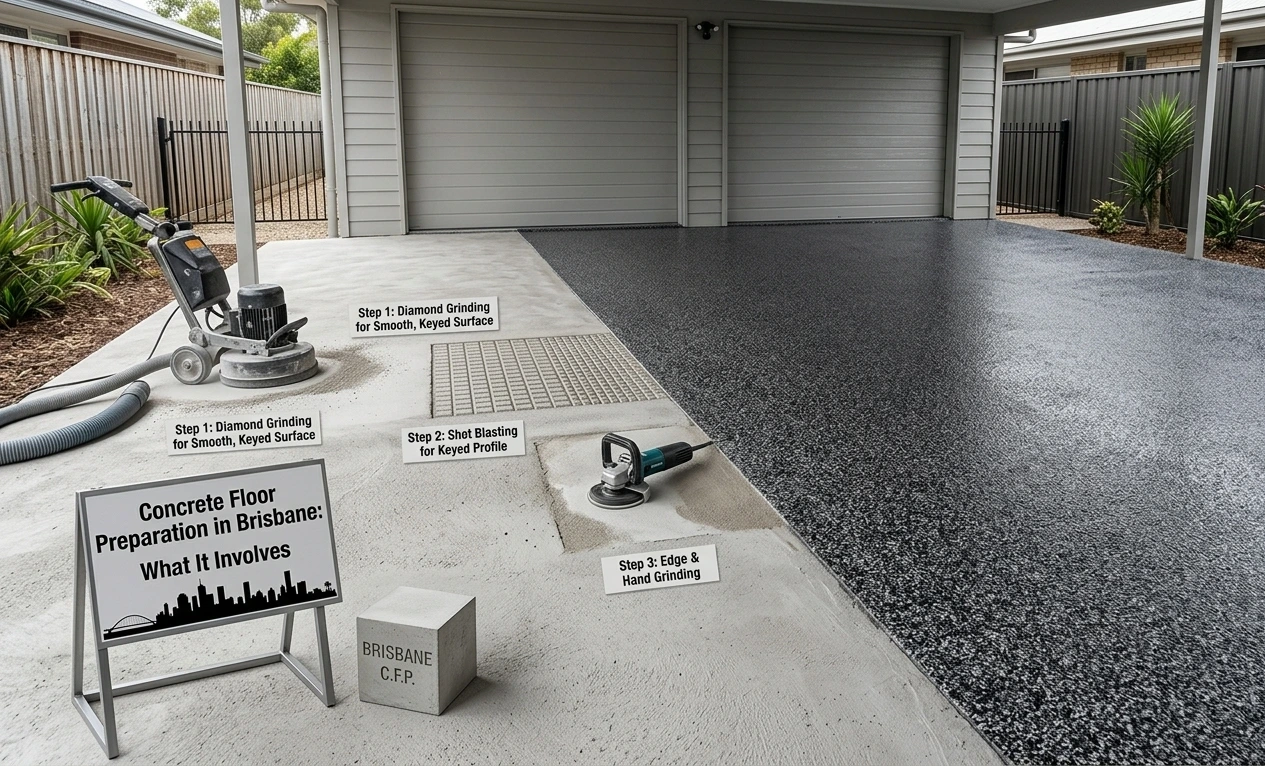
Diamond grinding uses rotating discs fitted with diamond-tipped segments to mechanically abrade the concrete surface. It removes laitance, light contamination, existing coatings, and surface irregularities while creating a consistent profile that coatings bond to. Diamond grinding produces a Concrete Surface Profile (CSP) of 1 to 3, which suits most residential and light commercial epoxy systems.
Diamond grinding is the preferred method for residential garages, indoor concrete floors, and decorative applications because it produces a clean, level profile without the row patterns that shot blasting can leave in the surface. Epoxy Brisbane uses industrial-grade diamond grinding equipment with integrated dust extraction on every residential and commercial project. The shot blasting service is available for projects where a deeper profile or heavier contamination removal is required.
Shot Blasting
Shot blasting propels recycled steel media at the concrete surface at high velocity, removing contaminated concrete and creating an aggressive, open surface profile. It produces a CSP of 4 to 6, which is required for high-build industrial epoxy systems, warehouse coatings, and food processing environments where maximum coating adhesion is critical.
Shot blasting is faster than diamond grinding over large areas, making it the preferred method for warehouses and industrial facilities. For decorative coating applications, a shot-blasted surface is typically followed by a diamond grind to achieve the level surface profile that decorative systems require. Epoxy Brisbane uses shot blasting as part of the preparation process for warehouse flooring and industrial coating projects.
Scarifying
Scarifying uses rotating cutting drums to aggressively remove damaged concrete, thick coatings, or significant surface defects. It creates a CSP of 7 to 9 and is used for substrates with severe damage, heavy build-up, or where bonded overlays and repair mortars are being applied. Scarifying is not used for standard epoxy coating applications; it is reserved for substrates that require significant material removal before the surface is brought back to a coatable condition.
What Is Concrete Surface Profile and Why Does It Matter for Epoxy Coatings?
Concrete Surface Profile (CSP) is a standardised rating system developed by ICRI (International Concrete Repair Institute) that describes the texture of a prepared concrete surface on a scale from 1 (near-smooth) to 9 (very rough). Every epoxy and resin coating product specifies a minimum CSP requirement that must be met before the product can be applied correctly.
| CSP Range | Typical Preparation Method |
| CSP 1 to 3 | Diamond grinding (thin epoxy, sealers, polished concrete) |
| CSP 4 to 6 | Shot blasting (high-build epoxy, industrial resin systems) |
| CSP 7 to 9 | Scarifying (bonded overlays, repair mortars) |
Applying a coating over a surface profile below the minimum specification creates a weak adhesion layer that fails under foot traffic, vehicle loads, or thermal cycling. This is why professional concrete floor preparation in Brisbane specifies the CSP target before selecting the preparation method, not the other way around.
Why Is Moisture Testing Required Before Epoxy Coating in Brisbane?
Concrete is a porous material that can transmit moisture vapour upward through the slab from the ground below. If a non-breathable epoxy coating is applied over a slab with excessive moisture vapour transmission, trapped moisture causes the coating to bubble, blister, or delaminate. In Brisbane, where ground moisture levels can be significant on ground-level slabs without adequate damp-proof membranes, moisture testing before application is a critical step.
Professional moisture testing uses calcium chloride tests or in-situ relative humidity probes to measure vapour transmission rates. If readings exceed the threshold specified by the coating manufacturer, a moisture barrier primer is applied before the base coat. This adds to the project cost and timeline but prevents coating failure from beneath.
Epoxy Brisbane conducts moisture testing as part of the preparation assessment on all projects where ground conditions or slab construction suggest elevated moisture risk. The epoxy coating process on residential and commercial projects reflects the moisture conditions found during assessment.
What Does Concrete Floor Preparation Include for an Epoxy Project?
A complete concrete floor preparation process for an epoxy coating project in Brisbane typically includes site assessment, diamond grinding or shot blasting to the specified CSP, crack and spall repair using epoxy patching compounds, moisture testing and moisture barrier application where required, decontamination of oil or chemical staining, and a final surface inspection before coating application begins.
For floors with more significant damage, the concrete resurfacing service provides substrate repair and levelling work before the coating system is applied. This step is common in older residential garages where concrete has cracked or spalled over time, and in industrial environments where years of forklift traffic or chemical exposure have degraded the surface.
What Happens When Concrete Floor Preparation Is Inadequate?
Inadequate concrete floor preparation produces a coating that fails prematurely. The most common failure modes are delamination, where the coating separates from the concrete in sheets; bubbling or blistering from moisture vapour trapped beneath a non-permeable coating; and peeling at edges or joints where the surface profile was insufficient for adhesion.
Remediation of a failed coating costs significantly more than correct preparation would have. The failed coating must be fully removed, the substrate prepared correctly, and the coating system reapplied. The total cost of fix and reapply is typically two to three times the cost of a correctly prepared original installation.
Epoxy Brisbane holds QBCC licensing and applies industry preparation standards on every project precisely to prevent these outcomes. The tile glue removal service handles substrates with adhesive or contamination that would compromise a coating applied without full preparation.
Proper Concrete Preparation Is What Makes Epoxy Floors Last
Every long-lasting epoxy floor in Brisbane begins with concrete preparation done to the correct standard. The coating system, finish selection, and topcoat all matter, but none of them perform as intended unless the substrate has been prepared correctly. Epoxy Brisbane is a QBCC-licensed contractor with direct experience in concrete floor preparation for residential, commercial, and industrial projects across Greater Brisbane. Call 1300 321 433 or enquire through our team to arrange an assessment of your concrete floor before any coating work begins.
Frequently Asked Questions
- What is concrete floor preparation in Brisbane?
Concrete floor preparation in Brisbane is the process of mechanically treating a concrete slab before applying epoxy, resin, or other coatings. It involves diamond grinding or shot blasting to create the correct Concrete Surface Profile, crack and spall repair, moisture testing, and contamination removal. Correct preparation determines whether the coating bonds properly and how long it lasts under use.
- What is the difference between diamond grinding and shot blasting for floor preparation?
Diamond grinding uses rotating diamond-tipped discs to abrade the surface to a CSP of 1 to 3, suitable for most residential and light commercial epoxy systems. Shot blasting uses steel media to aggressively profile the surface to a CSP of 4 to 6, required for high-build industrial coatings and heavily contaminated floors. Diamond grinding is preferred for decorative applications because it produces a cleaner, more level surface without the row patterns that shot blasting can leave.
- Is acid etching an acceptable alternative to diamond grinding for epoxy floors?
No. Acid etching is not a reliable substitute for mechanical preparation on any professional epoxy floor installation. Acid etching creates an inconsistent surface profile and does not remove contamination embedded in the concrete. It does not meet the preparation standard required by most epoxy coating manufacturers and is associated with premature coating failure. Mechanical preparation through diamond grinding or shot blasting is the industry-accepted method.
- How long does concrete floor preparation take in Brisbane?
The time required for concrete floor preparation depends on the floor area, the preparation method, and the condition of the slab. A standard residential garage floor typically requires one day for preparation including grinding, crack repair, and moisture testing. Larger commercial or industrial floors, or substrates with significant contamination or damage, take longer. Preparation is completed before any coating is applied, and coating typically begins the following day after preparation dust has settled.
- Does moisture in the concrete slab affect the cost of epoxy floor preparation?
Yes. If moisture testing reveals vapour transmission rates above the threshold specified by the coating system, a moisture barrier primer is required before the base coat can be applied. This adds material and an additional application step to the project. The cost of the moisture barrier is outweighed by the cost of coating failure and remediation that would occur if it were skipped on a slab with elevated moisture conditions.
- What concrete surface profile is needed for a residential garage epoxy floor in Brisbane?
Most residential garage epoxy systems require a Concrete Surface Profile of CSP 2 to CSP 3, achieved through diamond grinding. This profile opens the concrete pores sufficiently for a primer and epoxy base coat to form a mechanical bond, without creating a texture so rough that it affects the appearance of the decorative finish. The specific CSP target is determined by the coating manufacturer’s specification for the product being applied.
Book a Concrete Floor Assessment With Epoxy Brisbane
If you are planning an epoxy or resin coating for any floor in Brisbane, a concrete floor assessment should be the first step. Epoxy Brisbane evaluates substrate condition, identifies preparation requirements, and provides a quote based on what the floor actually needs. Call 1300 321 433 or submit your enquiry through our contact form to get started.
Key Takeaways
- Concrete floor preparation in Brisbane is the most critical phase of any epoxy or resin flooring project and directly determines how long the coating lasts.
- Diamond grinding creates a CSP of 1 to 3 and is used for most residential and light commercial epoxy applications.
- Shot blasting creates a CSP of 4 to 6 and is required for high-build industrial coatings and heavily contaminated surfaces.
- Concrete Surface Profile (CSP) is a standardised rating that determines which preparation method and coating system can be correctly applied.
- Moisture testing is required before epoxy is applied to identify slabs where vapour transmission would cause coating failure.
- nadequate preparation is the most common cause of epoxy floor failure in Brisbane and results in remediation costs significantly higher than correct preparation.
- Epoxy Brisbane is a QBCC-licensed contractor that conducts mechanical surface preparation to the correct specification on every residential, commercial, and industrial project.
