

Table of Contents
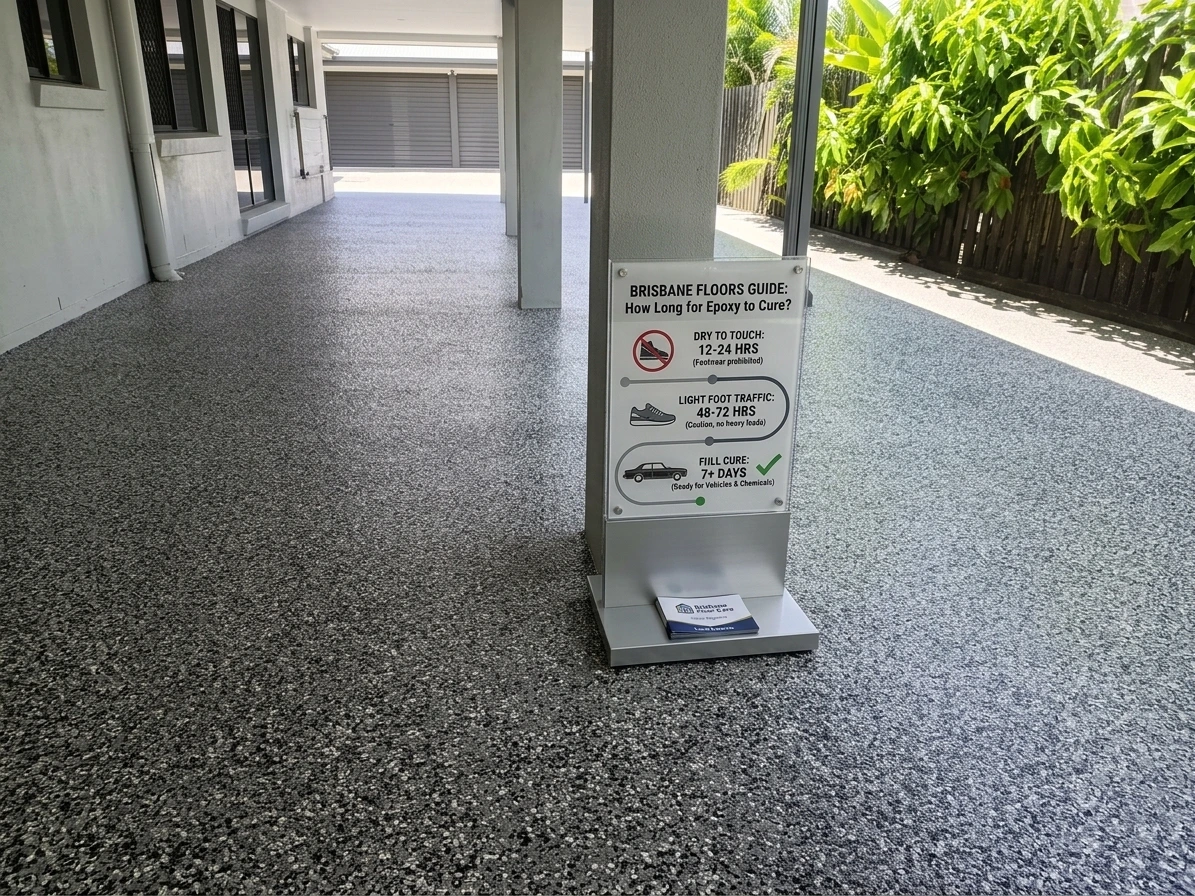
Epoxy cure time in Brisbane is driven primarily by temperature, with the seasonal range between a June winter and January summer installation creating meaningful variation. Humidity, substrate moisture, film thickness, and product type each contribute independently, and property owners can support faster cure by keeping the environment warm and maintaining ventilation to manage humidity. Epoxy Brisbane accounts for all of these variables on every installation.
The Variables That Control Epoxy Cure Speed
Epoxy cures through a chemical cross-linking reaction between the resin and hardener components. The speed of this reaction is governed by several variables that the installer and the property owner can influence to varying degrees. Understanding which variables are controllable, which are fixed by the product and environment, and which carry risk if manipulated incorrectly allows Brisbane property owners to make informed decisions about cure acceleration and to understand unexpected delays.
Variable One: Ambient and Substrate Temperature
How Temperature Affects Cure
Temperature is the single most powerful controllable variable in epoxy cure speed. The cross-linking reaction rate approximately doubles for every ten degrees Celsius increase in temperature. A floor installed at 15 degrees Celsius ambient takes roughly four times as long to reach each cure milestone as the same floor installed at 25 degrees Celsius. In Brisbane’s seasonal context, a winter installation at 15 degrees requires a vehicle access period of approximately ten to fourteen days where a spring installation at 25 degrees requires five to seven days.
Substrate temperature, meaning the temperature of the concrete slab itself, is as important as ambient air temperature for the early cure stages. Brisbane concrete slabs have significant thermal mass and lag behind ambient temperature changes. On a Brisbane winter morning where the ambient air has warmed to 18 degrees by 9am, the concrete slab may still be at 12 to 13 degrees from the overnight temperature, creating a cold substrate that slows the body coat cure during the critical initial hours even as the ambient temperature is rising.
The Bureau of Meteorology provides Brisbane’s historical monthly temperature averages, which give installers and property owners a reliable reference for understanding what ambient conditions to expect across the year when planning an installation window.
What Brisbane Property Owners Can Do
For a garage installation in Brisbane winter, a portable electric space heater running in the garage for twelve hours before installation warms the concrete slab to a temperature closer to the target 18 to 22 degree range and accelerates early cure stages measurably. After the body coat is applied, maintaining a warm curing environment with the heater running at low heat overnight extends the early cure period at higher temperature and reduces the total cure timeline.
Do not aim heat sources directly at the epoxy surface. Radiant heat applied directly to a curing epoxy surface creates a temperature gradient between the hot surface and the cooler interior of the film, which can produce surface bubbling or uneven cure. Maintaining a warm room temperature is more effective and safer than directing heat at the floor surface. This applies across all residential and commercial project types, from garage epoxy flooring installations to larger warehouse epoxy flooring projects where slab thermal mass is even more significant.
Variable Two: Relative Humidity
How Humidity Affects Cure
Relative humidity above 85 percent during the cure period creates amine blushing risk in professional two-part epoxy systems: atmospheric moisture reacts with amine hardener groups at the curing surface and produces a milky or waxy surface film that reduces topcoat adhesion and creates a visible surface defect. Brisbane’s wet season from December to February regularly produces ambient humidity above 85 percent on consecutive days, making this a genuine installation and cure risk for summer Brisbane projects.
Humidity above 85 percent also slows cure slightly in some epoxy formulations by interfering with the access of resin and hardener molecular groups to each other at the surface of the film where atmospheric moisture creates competition for the reactive sites. The combined effect of blushing risk and marginal cure retardation makes very high humidity conditions the most significant cure management challenge for Brisbane summer epoxy installations.
Safe Work Australia notes that environmental conditions in workplaces, including temperature and humidity, must be managed to minimise health and safety risks. The same principles of environmental monitoring apply to coating installations in commercial environments. Guidance is available on the Safe Work Australia website.
What Brisbane Property Owners Can Do
Running a dehumidifier in the curing space during Brisbane’s summer wet season reduces the ambient humidity within the enclosed garage or room to a level below the critical blushing threshold. A household dehumidifier set to maintain 60 to 70 percent relative humidity in the curing space during the first 24 hours of cure provides meaningful protection against amine blushing without creating a dry-air environment that might affect some moisture-cured primer formulations.
Ventilation that draws in cooler, less humid night air during the overnight cure period in Brisbane’s wet season reduces humidity exposure during the most critical early cure hours. Opening windows and running a fan to draw air through the space at 10pm to 6am, when Brisbane summer humidity is typically lower than at midday, creates a more favourable humidity environment for the initial cure phase.
Variable Three: Film Thickness
How Film Thickness Affects Cure
Thicker epoxy film applications generate more exothermic heat during cure because more cross-linking reaction is occurring per unit area. This self-generated heat in thicker applications can accelerate cure of the film interior relative to a thin film at the same ambient temperature. However, excessively thick single-coat applications, beyond the product’s specified maximum thickness per coat, can generate enough heat to create surface bubbling, cracking in the cooling film, or differential cure between the hot interior and the cooler surface layers.
Professional Brisbane installers apply each coat within the product data sheet’s specified wet film thickness range. This produces the intended dry film thickness and cure profile specified by the manufacturer. Applying more product per coat than specified does not produce a better floor: it produces a floor with cure quality issues that require remediation. The correct film thickness for each coat is specified in the product data sheet and is maintained using the application rate guidance provided by the manufacturer.
The Australian Building Codes Board (ABCB) sets the National Construction Code performance requirements for flooring systems in Australian buildings, which underpin the application standards professional installers follow to meet minimum performance benchmarks.
Variable Four: Product Chemistry and Formulation
Standard vs Fast-Cure Products
Professional epoxy product ranges include both standard and fast-cure formulations. Fast-cure amine hardeners use different chemistry that produces the cross-linking reaction at a faster rate under the same temperature conditions, reducing all cure stage timelines. A fast-cure 100% solid epoxy system in Brisbane’s typical conditions can reach light foot traffic in eight to twelve hours and vehicle access in three to four days rather than the five to seven days of a standard system. Fast-cure systems are specified when project scheduling requires earlier access milestones, such as a commercial kitchen installation that must return to service quickly or a residential installation timed around a short available window.
The trade-off of fast-cure formulations is a shorter pot life at any given temperature. A fast-cure system that reaches vehicle access in three to four days may have a pot life of twelve to fifteen minutes in Brisbane’s autumn conditions, compared to 25 to 30 minutes for a standard system. This shorter pot life requires more coordinated batch management and more experienced application crews to avoid defects from partially gelled material being applied in the final minutes of the pot life window.
Polyurethane and Polyaspartic Topcoats
Polyurethane and polyaspartic topcoats, applied as the final layer over a cured epoxy body coat, have fundamentally different cure chemistry from the epoxy body coat below them and cure significantly faster. A polyaspartic topcoat applied in Brisbane conditions can reach light foot traffic in one to two hours and full topcoat cure in 24 hours. This means that for installations where the epoxy body coat is applied on day one and the polyaspartic topcoat on day two, the floor can be at full domestic access by day three rather than the day four to five of a standard polyurethane topcoat system.
Variable Five: Substrate Contamination
How Contamination Slows or Prevents Cure
Oil, grease, and chemical contamination on the concrete substrate that was not fully removed during preparation can affect the cure quality of the primer and body coat in the contaminated zones. Oil contamination that reaches the primer-concrete interface interferes with the adhesion chemistry rather than directly with the cure reaction, but the result in an inadequately decontaminated zone is a primer that does not bond to the concrete below and therefore a body coat that does not develop the adhesion required to resist normal loads. The floor in the contaminated zone cures to its full hardness but at a fraction of its specified bond strength, producing localised delamination as the cure progresses and the polymer tries to cure against an unbonded substrate.
For Brisbane garage floors with oil contamination history, the degreasing and shot blasting preparation that removes the contaminated concrete layer before coating eliminates this cure interference risk. The preparation investment protects not just the adhesion quality of the installation but also the cure quality in previously contaminated zones.
What Never to Do to Try to Speed Up Epoxy Cure
Several approaches that Brisbane property owners sometimes attempt to speed up epoxy cure are either ineffective or counterproductive.
Increasing ventilation by opening windows and running fans does not speed up 100% solid epoxy cure: the cross-linking reaction does not require evaporation and is not accelerated by airflow. Ventilation during cure is beneficial for managing humidity and for removing any trace VOC from solvent-bearing systems, but it does not shorten the chemical cure timeline for 100% solids systems.
Applying heat directly to the epoxy surface with a heat gun or radiant heater creates a surface temperature that is significantly higher than the film interior. This accelerates surface cure while the interior lags, producing a hard surface skin over a still-soft interior that can buckle or crack as the interior cure catches up. Maintaining a warm room temperature without direct surface heat is the correct approach.
Walking on the floor or moving furniture back before the appropriate cure milestone to check whether it has reached that milestone creates exactly the damage that waiting for the milestone is intended to prevent. The floor does not benefit from being tested: it reaches each milestone in accordance with its cure chemistry and the conditions it is curing in. The Queensland Building and Construction Commission (QBCC) licenses the contractors responsible for applying these systems to professional standards, which includes managing cure conditions and advising clients on appropriate milestone timelines. To discuss the specific cure schedule for your Brisbane installation, contact Epoxy Brisbane on 1300 321 433.
Frequently Asked Questions
1. Can I use a heater to speed up epoxy cure in my Brisbane garage?
Yes, with the correct approach. A portable electric space heater that warms the garage ambient temperature to 22 to 25 degrees Celsius during the first 24 hours of cure meaningfully accelerates the cross-linking reaction and can shorten the touch-dry and light foot traffic stages by several hours. The heater should warm the room air rather than being directed at the floor surface. Overheating the room above 30 degrees Celsius provides diminishing returns and can create differential cure between the warm surface and the cooler lower film. In Brisbane’s winter, a room heater is the most practical and effective way to manage cure conditions for a residential garage epoxy flooring installation.
2. Does rain affect epoxy cure in a Brisbane garage?
A correctly installed Brisbane garage epoxy floor with the roller door closed is not directly exposed to rain during cure. If humidity within the garage rises above 85 percent during Brisbane’s wet season from rain-driven atmospheric moisture entering the garage, the amine blushing risk described above becomes relevant. Running a dehumidifier in the curing garage during wet-season installations maintains humidity within the safe range for cure quality even when Brisbane summer humidity outside is very high. Direct rain contact with a curing epoxy surface before touch-dry produces permanent surface defects that require professional remediation. For more on how Brisbane’s climate affects installation scheduling, see the Brisbane epoxy flooring service overview.
3. Why is my Brisbane epoxy floor still soft after three days?
A Brisbane epoxy floor that remains soft after three days is experiencing slower than normal cure, which has one or more root causes. Cold substrate or ambient temperature below 15 degrees Celsius slows the cross-linking reaction dramatically. High humidity during cure may have produced amine blushing that created a soft surface layer. An incorrect resin-to-hardener ratio from incomplete mixing produces a floor with insufficient hardener to complete the cross-linking reaction fully, leaving excess unreacted resin in a permanently soft state. Substrate contamination that interferes with primer adhesion can create a soft zone in the primer that feels soft underfoot even when the body coat above it has healed. Each of these causes requires a different response: professional assessment is needed to identify the correct diagnosis before any remediation proceeds. Contact Epoxy Brisbane on 1300 321 433 to arrange an assessment.
4. Does the epoxy floor in my Brisbane garage keep curing after I start using it?
Yes. The cross-linking reaction continues progressing toward full chemical cure for seven to thirty days after the final topcoat is applied. During the vehicle access period from day five to seven onward, the floor is in service but its chemical resistance and ultimate hardness are still developing. This is why harsh cleaning chemicals should be avoided until the seven-day chemical cure milestone is reached even after normal vehicle access has resumed. Using the floor appropriately during this maturing period does not slow the cure: normal residential and vehicle use is fully compatible with the ongoing cure chemistry during this phase. The how to maintain epoxy floors guide covers appropriate cleaning products and care routines for this period.
Manage Your Brisbane Epoxy Floor Cure Conditions for the Best Result
Every variable that affects epoxy cure speed in Brisbane conditions is known and manageable with the right product specification and installation scheduling. Epoxy Brisbane accounts for temperature, humidity, and seasonal conditions in every Brisbane installation and provides specific cure stage guidance for each project. QBCC-licensed. Call 1300 321 433 or visit the maintenance guide on the Epoxy Brisbane website for ongoing care guidance after your Brisbane installation.
Key Takeaways
- Temperature is the dominant variable: cure rate approximately doubles for every 10 degrees Celsius increase. Brisbane winter extends all cure timelines by one to two days.
- Humidity above 85 percent creates amine blushing risk. Run a dehumidifier in the curing space during Brisbane’s wet season.
- Warm the room, not the surface. A space heater raising garage temperature to 22 to 25 degrees accelerates cure without the differential cure risk of direct surface heating.
- Film thickness beyond the specified maximum causes exothermic heat build-up and differential cure. Apply within the product data sheet specification.
- Fast-cure formulations reduce vehicle access to three to four days but have shorter pot life of 12 to 15 minutes, requiring experienced application crew.
- Oil contamination in the substrate does not slow the cure reaction but compromises bond strength in the contaminated zone, producing localised delamination.
- Increasing ventilation does not speed 100% solids epoxy cure. Direct surface heat is counterproductive. Walking on the floor to test cure milestone readiness creates the damage the waiting is intended to prevent.
